


If you own a mobile or manufactured home and you are researching heating and cooling options, you have likely come across the term "package heat pump" alongside more familiar names like central air or split system. For many homeowners, it is not immediately clear what a package unit actually is, how it works, or why it tends to be the standard recommendation for mobile homes specifically rather than the split systems commonly used in traditional site-built houses.
At The AC Outlet, we install and service package heat pump units for mobile home owners regularly, and this is one of the most common starting points for customers beginning to explore their HVAC options. This guide breaks down exactly what a package heat pump is, how it functions, and why it has become the standard choice for mobile and manufactured housing.
What a Package Heat Pump Actually Is
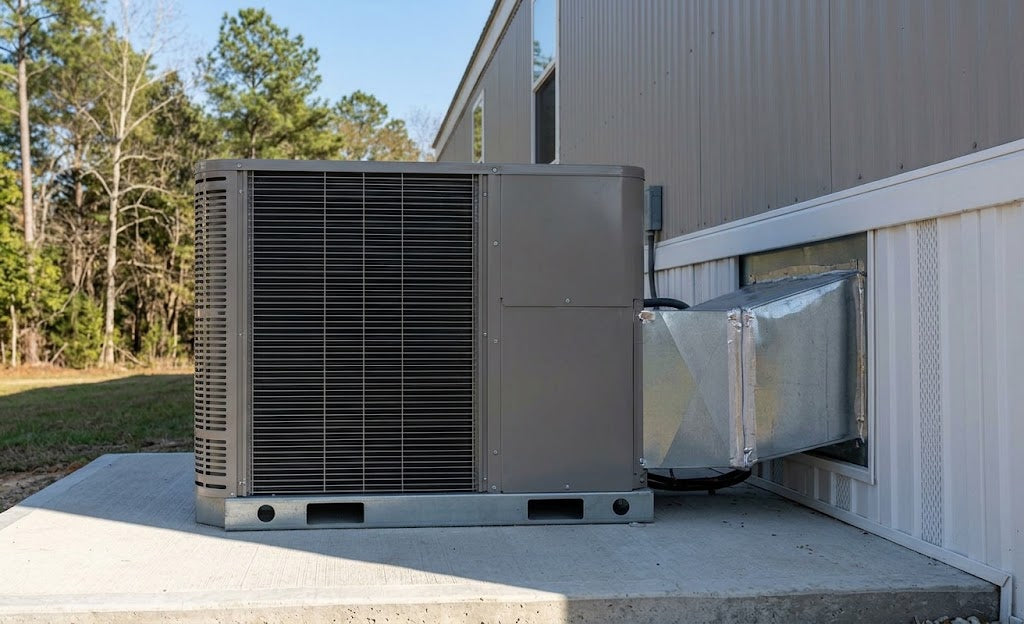
A package heat pump is a single, self-contained HVAC unit that combines all the major components needed for both heating and cooling into one outdoor cabinet. Unlike a traditional split system, which separates the compressor and condenser (installed outside) from the air handler and evaporator coil (installed inside, often in an attic, closet, or basement), a package unit houses the compressor, condenser coil, evaporator coil, and air handling components all within a single enclosure, typically installed just outside the home.
The term "package" refers to this all-in-one design. Everything needed to heat and cool the home is packaged together in one unit, rather than split across separate indoor and outdoor components connected by refrigerant lines running through the walls or roof.
For mobile homes, this design has practical advantages that make it particularly well suited to the way these homes are typically constructed, which we will cover in more detail shortly.
How a Package Heat Pump Works
A package heat pump operates on the same basic principle as any heat pump system: rather than generating heat directly the way a furnace does, it moves heat from one location to another. In cooling mode, it extracts heat from inside the home and releases it outside, the same basic process used in any air conditioning system. In heating mode, it reverses this process, extracting available heat from the outdoor air, even when temperatures are relatively cool, and transferring that heat into the home.
This reversible capability is what distinguishes a heat pump from a standard air conditioner, which can only cool. A heat pump package unit provides both heating and cooling from a single system, using a reversing valve to switch between modes depending on the season and the home's thermostat settings.
Within the package unit itself, refrigerant circulates through a closed loop, passing through the compressor, condenser coil, and evaporator coil in sequence. The compressor pressurizes the refrigerant, raising its temperature, while the coils facilitate the heat exchange process, either releasing heat outdoors during cooling mode or absorbing available heat from outdoor air during heating mode. A blower fan within the unit then pushes conditioned air through the home's ductwork, delivering heated or cooled air to each room.
Because all of this happens within a single outdoor cabinet, the connection to the home itself is relatively simple compared to a split system. A package unit connects to the home's ductwork through supply and return openings, typically through the home's exterior wall or, in many mobile home installations, through openings in the floor or belly of the home, rather than requiring refrigerant lines to be run between separate indoor and outdoor components.
How Package Units Differ From Split Systems
The most fundamental difference between a package unit and a split system comes down to component location. A split system divides the compressor and condenser (outdoor components) from the evaporator coil and air handler (indoor components), connecting the two with refrigerant lines that typically run through walls, attics, or crawl spaces. A package unit consolidates all of these components into a single outdoor cabinet, connecting to the home only through ductwork rather than refrigerant lines.
This difference has several practical implications. Split systems generally require more available indoor space to accommodate the air handler, whether in a closet, attic, or utility area. Package units eliminate this requirement entirely, since there is no separate indoor air handler taking up interior space. Installation for split systems also typically involves running refrigerant lines between the outdoor and indoor components, which requires more extensive line work and, in some cases, more complex installation depending on the distance between components. Package units simplify this considerably, since all refrigerant components remain within the single outdoor cabinet.
Maintenance and servicing also differ somewhat between the two configurations. With a split system, a technician may need to access both an outdoor unit and an indoor air handler to fully service the system. With a package unit, nearly all serviceable components are accessible from a single outdoor location, which can simplify routine maintenance and repairs.
Why Package Units Are Commonly Used in Mobile and Manufactured Homes
Package heat pumps have become the standard recommendation for mobile and manufactured homes for several practical reasons rooted in how these homes are typically constructed.
Limited interior space. Mobile homes are generally built with less available interior space for mechanical equipment compared to traditional site-built houses. A split system's air handler requires a dedicated interior location, whether a closet or utility space, which can be difficult to accommodate in the more compact floor plans common to manufactured housing. A package unit's outdoor installation eliminates this constraint entirely, freeing up interior space for living areas rather than mechanical equipment.
Simplified installation given home construction. Mobile homes are often constructed with specific ductwork configurations, frequently routed beneath the home through the belly, that are well suited to connecting directly to an outdoor package unit. This construction approach makes package unit installation more straightforward in many manufactured homes compared to retrofitting a split system design that was originally developed with traditional home construction in mind.
Manufacturing and transport considerations. Many manufactured homes are built with HVAC connection points designed specifically around package unit installation from the factory, since this configuration has become an industry standard for the manufactured housing sector. This means package units are often the most straightforward option to install without requiring modifications to the home's existing structure.
Consolidated servicing. Because a package unit's compressor, coils, and air handling components are all located in one place outside the home, service technicians can typically perform maintenance, diagnostics, and repairs without needing to access the home's interior at all, which can be a meaningful convenience for homeowners.
At The AC Outlet, the vast majority of mobile home installations we handle involve package units, precisely because this configuration aligns so well with how mobile and manufactured homes are typically built.
What This Means for Your Mobile Home
If you are considering a new HVAC system for a mobile home, understanding how a package heat pump works helps clarify why this option is so frequently recommended over a split system for this specific type of housing. The all-in-one design simplifies installation, preserves valuable interior space, and aligns well with the ductwork configurations common to manufactured homes.
That said, a package heat pump is not automatically the only option worth considering, and there are situations where a split system may still be appropriate depending on a home's specific layout and existing infrastructure. If you want a closer look at how these two options compare directly, including cost, performance, and installation differences specific to mobile homes, we cover that in detail in our companion guide, Package Heat Pump vs. Split System: Which Is Better for Mobile Homes?
Final Thoughts
A package heat pump combines everything needed for heating and cooling into a single, self-contained outdoor unit, making it a practical and widely used solution for mobile and manufactured homes. Its space-saving design, simplified installation, and compatibility with typical mobile home construction have made it the standard choice across the manufactured housing industry.
At The AC Outlet, we help mobile home owners choose, install, and maintain package heat pump systems suited specifically to their home's size, layout, and climate needs. If you are unsure whether a package unit is the right fit for your home, our team can walk you through the specifics based on your home's actual construction and heating and cooling requirements.


