


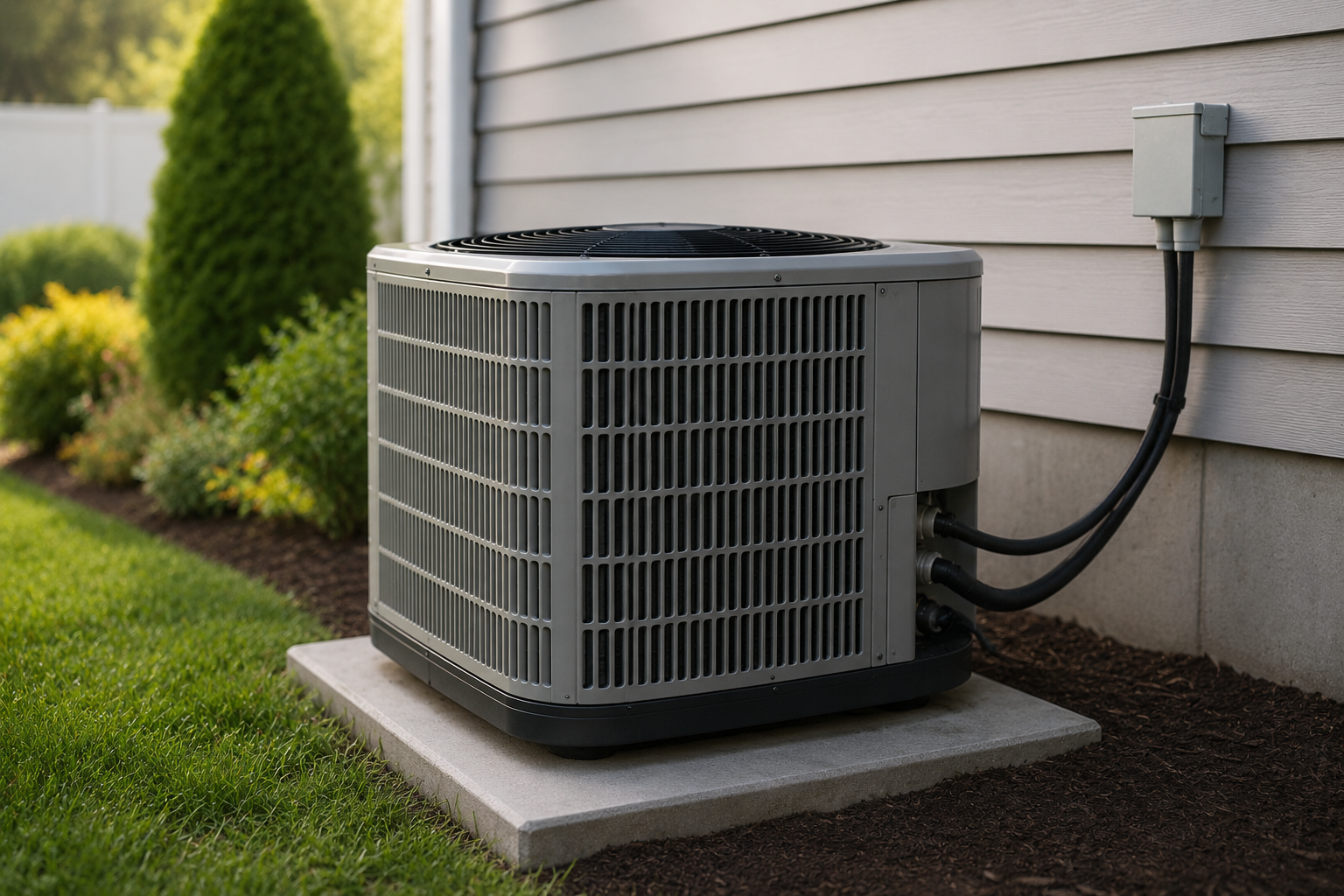
Replacing an AC condenser is one of the bigger home purchases most people make — and yet most homeowners go into it knowing almost nothing about what they're actually buying. The contractor shows up, quotes a unit, and the homeowner says yes or no based almost entirely on the number at the bottom of the page.
That's understandable. It's not like buying a TV where you can read reviews and compare specs side by side. But it also means most people make a $3,000 to $6,000 decision with less information than they'd use to buy a laptop.
This article covers the things that rarely get explained — the decisions, trade-offs, and details that make a real difference to how your new condenser performs, how long it lasts, and whether you're genuinely getting value for your money.
The SEER Rating Is More Important Than the Brand Name
The first number you should look at when comparing AC condensers isn't the price — it's the SEER rating. SEER stands for Seasonal Energy Efficiency Ratio, and it measures how efficiently the unit converts electricity into cooling. The higher the SEER, the less electricity the unit uses to produce the same amount of cooling.
As of 2023, the minimum SEER rating for new residential AC equipment sold in most of the US is 14 or 15 depending on your region (the Southwest and Southeast require higher minimums due to climate demands). Units are available up to SEER 26 and beyond.
Here's what most contractors don't explain clearly: the difference in operating cost between a 14 SEER and an 18 SEER unit can easily pay for the price difference within five to seven years — sometimes sooner depending on how much you run the system and what you pay for electricity. In climates where AC runs six months of the year, efficiency compounds quickly.
The conversation with a contractor often defaults to "this is the standard unit we install" without walking you through what a higher efficiency option would actually cost you over time. Ask for that comparison before you decide.
Tonnage Matters More Than Most People Realise — and Bigger Isn't Better
AC capacity is measured in tons — not because the unit weighs that much, but as a legacy unit of measurement for cooling capacity. A 1-ton unit removes 12,000 BTUs of heat per hour. Residential systems typically range from 1.5 tons to 5 tons.
The most common sizing mistake homeowners make is assuming a bigger unit will cool the house better. It won't. An oversized condenser cools the space too quickly, short-cycles (turns on and off in rapid bursts), and never runs long enough to remove meaningful humidity from the air. The result is a home that feels cold but clammy — and a system that wears out faster because of the constant stop-start cycling.
Proper sizing requires a Manual J load calculation — a formal assessment of your home's square footage, ceiling height, insulation levels, window orientation, local climate, and other factors. Any contractor who quotes a replacement unit based purely on the size of the old unit or a quick square footage estimate without doing a proper load calculation is cutting corners. The right size for your home may be different from what was installed originally, especially if you've added insulation, replaced windows, or made other improvements since the original installation.
The Condenser Is Only Half the System
This is the one that catches people most by surprise.
The outdoor condenser unit works in tandem with the indoor air handler or furnace coil. These two components are engineered to work together — they need to be matched in both capacity and refrigerant type to operate at their rated efficiency. Installing a new high-efficiency condenser with an old, mismatched air handler is like putting a high-performance engine in a car with a deteriorating transmission.
When the indoor and outdoor units are mismatched, you lose efficiency, you put additional stress on the new compressor, and you may void the manufacturer's warranty. Many warranty claims on new condensers are denied specifically because the indoor unit wasn't replaced or inspected at the same time.
This doesn't automatically mean you need to replace the air handler every time you replace the condenser — but it does mean you need to know the condition, age, and compatibility of the existing indoor unit before making the decision. A contractor who doesn't raise this conversation isn't necessarily cutting corners, but it's worth asking directly.
Refrigerant Type Is a Decision You'll Live With for a Long Time
Older AC systems use R-22 refrigerant, which was phased out of production in 2020 under the Clean Air Act. If your existing system uses R-22, you're already in a position where repairs requiring refrigerant are expensive and increasingly difficult. Any new condenser you install will use R-410A or the newer R-454B / R-32 refrigerants, which are the current standard.
This is mostly straightforward — you won't be buying a system that uses a phased-out refrigerant. But the detail worth knowing is that the industry is currently in another transition period. R-410A is itself being phased out by 2025 under updated EPA regulations, with R-454B becoming the new standard for residential equipment.
This doesn't mean R-410A systems being installed now are bad purchases — they have warranties, full manufacturer support, and will operate normally for their full lifespan. But it's worth understanding that if you're looking at a unit designed around R-454B, you're buying into a longer support horizon, which matters when you're planning for 15+ years.
Ask your supplier which refrigerant type the unit uses and what the manufacturer's long-term support position is. At The AC Outlet, we're happy to walk through this for any unit in our range.
The Warranty Has More Variables Than You Think
Most new condensers come with a compressor warranty of 5 to 10 years and a parts warranty of the same or shorter duration. These sound reassuring until you read the conditions.
Most manufacturer warranties require:
Professional installation by a licensed HVAC contractor. DIY installation typically voids the warranty entirely, and some manufacturers require documentation of professional installation to process any claim.
Registration within 60 to 90 days of installation. Many manufacturers offer an extended warranty — often an additional 5 years — if the product is registered within this window. It's a simple online process that most homeowners don't do because the contractor doesn't mention it, and it can mean the difference between a 5-year and a 10-year warranty.
Annual professional maintenance. Some warranties include a clause requiring documented annual service to remain valid. If the system fails at year 8 and you haven't had it serviced, the claim may be denied.
Matched system components. As mentioned above, using a mismatched indoor unit can void the outdoor unit's warranty.
Read the warranty documentation before you finalise the purchase. The headline number (10-year compressor warranty) is only valid if the conditions are met.
Installation Quality Affects Performance More Than Equipment Quality
You can buy the most efficient condenser on the market and still end up with a system that performs poorly if the installation isn't done right. The factors that matter most:
Refrigerant charge. The amount of refrigerant in the system needs to be precisely set to the manufacturer's specification. An overcharged or undercharged system runs inefficiently, stresses the compressor, and can fail prematurely. Proper charging requires measurement equipment and takes time — if the contractor seems to be in and out very quickly, it's worth asking how the charge was verified.
Electrical connections and line sizing. The condenser needs to be connected to a dedicated circuit with correctly sized wiring and breaker. Undersized wiring creates a safety hazard and affects performance.
Pad and clearance. The outdoor unit needs to be level, on a stable pad, with adequate clearance on all sides for airflow. Units installed too close to walls, fences, or dense vegetation run hotter and less efficiently.
Duct condition. A new, efficient condenser pushing air through leaky, undersized, or poorly insulated ductwork delivers a fraction of its rated performance. If your ductwork is old and hasn't been inspected recently, it's worth doing so at the same time as the replacement.
The Price You See Online vs. The Price You Pay
If you've been shopping for condensers online, you may have noticed that unit prices vary significantly between retailers. One thing worth understanding is that the price of the condenser itself is typically only part of the total cost — installation labour, refrigerant, electrical work if needed, disposal of the old unit, and any necessary ductwork repairs are all separate.
When comparing quotes, make sure you're comparing total installed cost, not just equipment cost. A unit that's $400 cheaper to buy but $600 more expensive to install isn't actually cheaper.
Buying the equipment yourself through a supplier like The AC Outlet and hiring a licensed contractor to install it is an increasingly common approach that gives homeowners more control over both the product selection and the total cost. You choose the unit based on the specs that matter to you — efficiency, capacity, warranty, refrigerant type — rather than whatever a contractor happens to carry.
What to Actually Ask Before You Buy
To summarise everything above in practical terms, here are the questions worth asking before committing to any new condenser:
-
What is the SEER rating, and how does the operating cost compare to a higher-efficiency alternative?
-
Has a proper Manual J load calculation been done to confirm the correct tonnage?
-
Is the indoor air handler compatible with this unit, and should it be replaced at the same time?
-
What refrigerant type does this unit use?
-
What are the warranty conditions — registration requirement, maintenance requirement, matched system requirement?
-
What is the total installed cost, not just the equipment cost?
A condenser is a long-term investment. The right one, properly sized, correctly installed, and well maintained will deliver reliable, efficient cooling for 15 years or more. The wrong one — or the right one installed poorly — will cost you in efficiency, repairs, and early replacement.
Browse The AC Outlet's full range of residential condensers — we carry units across all efficiency ratings, capacities, and refrigerant types, with full specification details to help you make the right choice for your home.


