


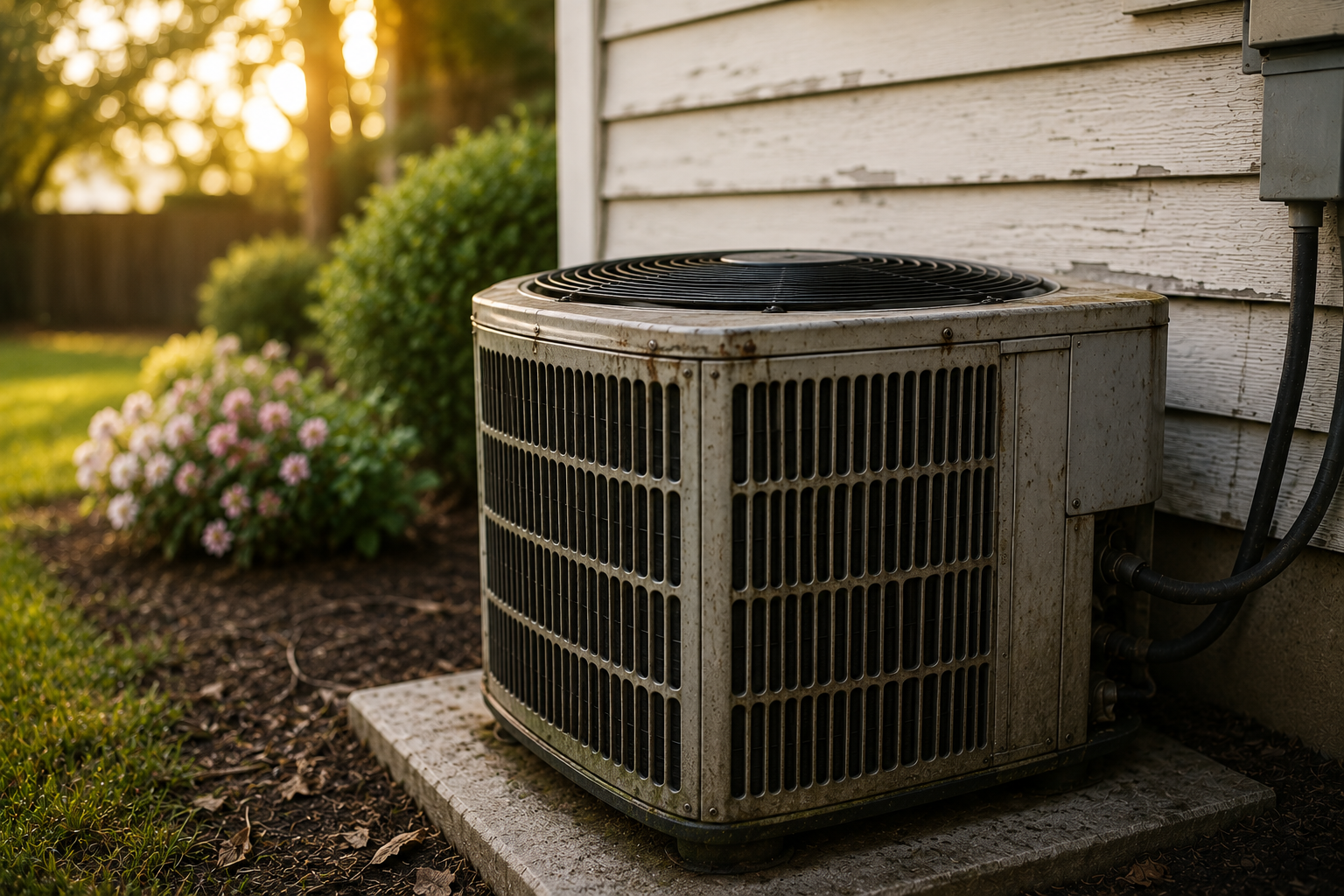
Most homeowners don't think about their AC condenser until it stops working — usually on the hottest day of the year, with a house full of people and nowhere to go. By that point, the decision about whether to repair or replace gets made under pressure, without time to research properly, and often at emergency pricing.
The better approach is to understand where your system stands before it fails. A condenser that's heading toward the end of its life gives you signals — sometimes months or even years in advance. Knowing what to look for means you can plan the replacement on your terms, not the system's.
Here's what you should know about condenser lifespan, what shortens it, and the specific signs that tell you yours is nearing the end.
The Honest Answer on Lifespan
A well-maintained residential AC condenser typically lasts between 15 and 20 years. That's the honest middle range — not the optimistic number manufacturers sometimes quote, and not the pessimistic one you might hear from a contractor eager to make a sale.
The actual lifespan of any given unit depends on several factors that vary considerably from home to home:
Climate. Condensers in hot, humid climates run far more hours per year than those in mild climates. A condenser in Phoenix or Miami might accumulate the same operational hours in 10 years that a condenser in Seattle takes 20 years to reach. More hours means more wear on the compressor, capacitors, contactors, and fan motor — the components that determine how long the system survives.
Maintenance history. A condenser that receives annual professional maintenance — coil cleaning, refrigerant level check, electrical inspection, lubrication of moving parts — consistently outlasts one that runs indefinitely without service. Dirty coils force the compressor to work harder, and a compressor that runs harder runs hotter and wears faster.
Installation quality. A unit that was correctly sized, properly charged with refrigerant, and installed on a level pad with adequate clearance starts its life in good condition. A unit that was oversized, undercharged, or improperly installed starts with disadvantages that compound over time.
Manufacturer and component quality. Not all condensers are built to the same standard. Premium components — particularly the compressor, which is the most expensive single part in the system — vary significantly in quality between manufacturers and price tiers.
Given all of these variables, the practical takeaway is this: if your condenser is under 10 years old and has been reasonably maintained, repairs are almost always the right answer. If it's over 15 years old, you should be planning for replacement even if it's still running — because failure is a matter of when, not if. The 10-to-15-year window is where the analysis gets more nuanced, and where the signs below become most important.
8 Signs Your Condenser Is Nearing the End
1. It's Running But Not Cooling
If your AC is running continuously but the house isn't reaching the set temperature — or takes significantly longer to cool than it used to — the condenser is likely losing capacity. This happens gradually as the compressor wears and refrigerant levels drift. It's easy to attribute to unusually hot weather, but if it becomes a pattern across multiple summers, the system is declining.
A system that runs constantly without hitting the target temperature is also burning significantly more electricity than it should. The efficiency loss that accompanies age is often invisible until you compare this summer's electricity bills to bills from five years ago.
2. The Compressor Starts Then Immediately Shuts Off (Hard Starting)
Hard starting — where the compressor struggles to start, runs briefly, then shuts off — is one of the clearest mechanical distress signals a condenser can give. It's often caused by a failing capacitor or a compressor that's drawing more current than it should as it ages.
A failing capacitor is a relatively inexpensive repair. But if the capacitor has already been replaced once and the hard starting persists, the compressor itself may be the underlying cause — and a compressor replacement on an old unit is rarely cost-effective compared to full replacement.
3. It's Making Noises It Didn't Used to Make
Every condenser makes some noise — the hum of the compressor, the sound of the fan blades moving air. What you're listening for is new sounds that weren't there before:
Rattling or banging often indicates loose components, debris in the unit, or a failing fan motor bearing. Usually repairable if caught early.
Grinding or screeching suggests worn fan motor bearings or compressor problems. More serious.
Clicking on startup or shutdown in isolation is often normal. Persistent clicking during operation can indicate an electrical relay failing.
Hissing or bubbling can indicate a refrigerant leak. Refrigerant leaks don't fix themselves — the system will continue to lose charge until it fails to cool at all.
Any new, unusual noise warrants a service call rather than being left to "see what happens."
4. Refrigerant Keeps Needing to Be Topped Up
A properly functioning AC system is a closed loop — it doesn't consume refrigerant. If a technician has topped up your refrigerant more than once in the past few years, you have a leak. Refrigerant leaks can occur in the condenser coil, the line set, or connections throughout the system.
Small leaks can sometimes be repaired. But in an aging system, a refrigerant leak is often the beginning of a pattern rather than an isolated event. The repair cost also needs to be weighed against the age of the system — paying several hundred dollars to fix a leak in a 14-year-old condenser that will need replacement within a few years anyway rarely makes financial sense.
5. Energy Bills Are Climbing Without Explanation
An aging condenser loses efficiency gradually — typically around 5% per year in the later stages of its life. This shows up on your electricity bill before it shows up as a comfort problem. If your cooling costs have increased year over year without a corresponding increase in usage or electricity rates, the system is working harder for the same result.
A new high-efficiency condenser (SEER 16–18 and above) can reduce cooling costs by 30–50% compared to an aging 10 SEER unit. In high-cooling climates, the annual savings can be substantial enough to meaningfully offset the cost of replacement over a reasonable timeframe.
6. It Needs Frequent Repairs
A single repair on an aging condenser isn't necessarily a sign to replace it. Two or more repairs within a few years is a pattern worth examining. The general rule of thumb used by HVAC professionals is the 5,000 rule: if the cost of the repair exceeds 50% of the value of the system (age-adjusted), replacement is the better investment.
If you've spent $800 on capacitor and contactor replacements over the past two summers, and the system is 13 years old with a current value of maybe $1,500, the next significant repair — a refrigerant leak, a failing fan motor, or a compressor issue — is likely to push the cumulative repair cost past the replacement threshold.
7. The Coils Are Corroding
The condenser coil — the network of copper or aluminium tubing and fins that releases heat from the refrigerant to the outside air — is vulnerable to corrosion over time, particularly in coastal environments where salt air is present, or in areas with high concentrations of certain chemicals in the air.
Corroded coils lose efficiency and eventually develop leaks. A service technician can inspect the coil condition during routine maintenance. Mild oxidation is normal and manageable. Significant corrosion with visible pitting or pinhole damage means the coil itself is compromised, and repairing or replacing a condenser coil on an aging unit often costs more than the unit is worth.
8. It Uses R-22 Refrigerant
R-22 (also known as Freon) was phased out of production in 2020 under Clean Air Act regulations due to its ozone-depleting properties. If your system was installed before approximately 2010, there's a reasonable chance it uses R-22.
R-22 systems can still be serviced using reclaimed refrigerant, but the supply is finite, the cost is high (often $50–$150 per pound compared to $5–$10 per pound for R-410A), and it will only become more expensive and difficult to source over time. If your R-22 system develops a refrigerant leak requiring recharging, the repair cost alone may justify replacement with a current-refrigerant system.
The Repair vs. Replace Decision
When a condenser shows one of the signs above, the decision tree looks like this:
Under 10 years old: Repair almost always makes sense unless the compressor itself has failed, which is a major repair on a relatively young unit worth evaluating carefully.
10 to 15 years old: Evaluate each repair on its own cost relative to the system's remaining likely lifespan. Multiple repairs in this window is a strong indicator to plan replacement rather than keep spending on a declining asset.
Over 15 years old: Replacement planning should be underway regardless of current condition. At this age, the question isn't whether the system will fail — it's when. Planning ahead means replacing on your schedule, at standard pricing, with time to research the right equipment. Waiting for failure means replacing under pressure, often at emergency rates, in the middle of summer.
Planning Ahead Makes All the Difference
The homeowners who get the best outcome on condenser replacement are the ones who start thinking about it before they have to. They have time to compare equipment specifications, understand efficiency ratings, and choose the right unit for their home rather than accepting whatever is available for quick installation.
If your condenser is approaching the 12-to-15-year mark, now is the right time to start that process — not because it will definitely fail soon, but because being prepared costs nothing and being unprepared costs a great deal.
The AC Outlet carries a full range of residential condensers across all efficiency ratings and capacities. If you know your current unit's age and tonnage, our product range makes it straightforward to find a well-matched replacement — browse at your own pace before you need to make a decision under pressure.


