


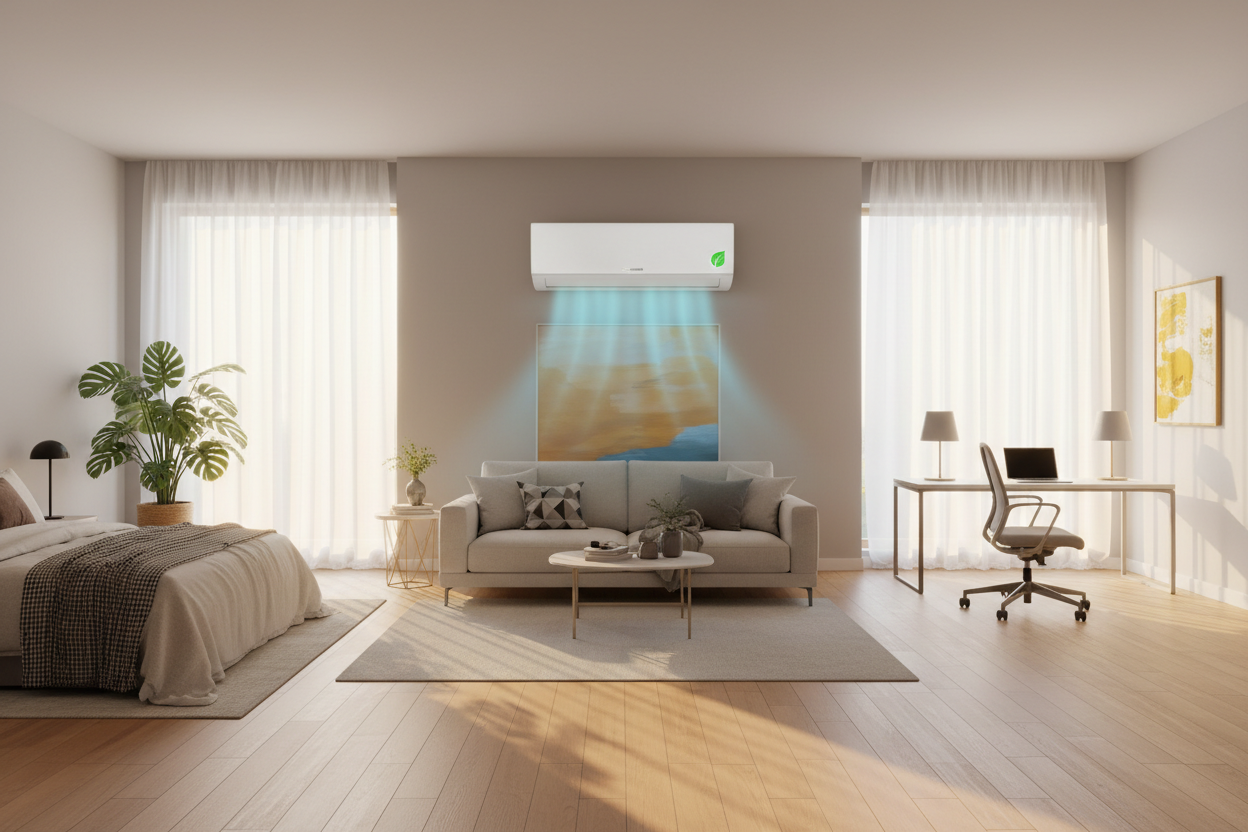
Buying an air conditioner without looking at efficiency ratings is like buying a car without checking the fuel economy. The sticker price is just the beginning — what you pay every month to run the thing is where the real cost lives. A cheap, inefficient AC unit running through a full Texas or Florida summer can cost you $40–$80 more per month in electricity than a properly sized, high-efficiency model.
This guide breaks down the best energy-efficient air conditioners by room size for summer 2025 — from compact window units for small bedrooms to high-SEER central systems for large homes. Every recommendation prioritizes efficiency without sacrificing the cooling power you actually need when temperatures peak.
What Makes an Air Conditioner "Energy Efficient"?
Before getting into picks, it's worth understanding what efficiency ratings mean so you can compare options yourself.
SEER (Seasonal Energy Efficiency Ratio)
Used for central AC systems and mini-splits. Measures total cooling output over a full cooling season divided by total electrical energy input. Higher SEER = lower operating cost. The federal minimum SEER is 14 in most US regions (13.4 in the Southwest and Southeast under new 2023 standards). High-efficiency units run 18–26+ SEER.
EER (Energy Efficiency Ratio)
Used for window and portable AC units. Measures cooling output at a single operating condition (95°F outdoor, 80°F indoor, 50% humidity). Less comprehensive than SEER but useful for direct window-unit comparisons. Look for EER 12 or higher for a genuinely efficient window unit.
CEER (Combined Energy Efficiency Ratio)
The newer standard for room air conditioners replacing EER. Accounts for standby power draw in addition to active cooling — a more accurate real-world efficiency number. Energy Star-certified room ACs require a minimum CEER of 12.1 for most sizes.
Energy Star Certification
An Energy Star-certified AC unit is independently verified to use 10–15% less energy than the federal minimum standard. It's not a guarantee of the most efficient product on the market, but it's a reliable floor — anything below Energy Star certification is leaving money on the table over a summer season.
Why Efficiency Matters More Than Ever in Summer 2025
Electricity rates across the US have increased 15–25% over the past three years in most markets. Running an old 10 SEER central system costs roughly twice as much per cooling hour as running a new 20 SEER system delivering the same output. Over a 4–6 month summer cooling season, that gap is hundreds of dollars.
The efficiency decision also compounds with sizing. An oversized, inefficient unit that short-cycles is the worst-case scenario — you pay for the wasted capacity on every electric bill. Getting the right size and right efficiency rating together is where the real savings live.
Not sure about your size? Read our complete AC sizing guide
Best Energy-Efficient Window AC Units (Small to Mid-Size Rooms)
Window units have improved dramatically in the past five years. Modern Energy Star certified models run at CEER ratings of 12–14+, compared to the 8–10 EER of older units still in millions of US homes. If you're running a window unit more than five years old, replacing it with a current-generation Energy Star model typically delivers $30–$60 in annual electricity savings per unit.
Best for Small Bedrooms & Home Offices (Up to 350 sq ft) — 5,000–8,000 BTU
What to look for:
- Energy Star certified (CEER 12.1 minimum)
- Sleep mode or programmable 24-hour timer to avoid running at full power overnight
- Eco or energy-saver mode that cycles the fan off when compressor shuts off (reduces energy use by 30–40% vs. fan-always-on mode)
- Washable filter for low maintenance
- Noise rating under 50 dB for bedroom use
Key efficiency features that separate the best from the rest at this size:
A properly sized 6,000 BTU Energy Star window unit for a 200 sq ft bedroom costs approximately $0.07–0.10 per hour to run. A non-certified older unit of the same BTU rating can run $0.12–0.16/hr — a gap that adds up to $40–$60 over a cooling season on a single room.
Shop 5,000–8,000 BTU window AC units at The AC Outlet
Best for Large Bedrooms & Living Rooms (350–700 sq ft) — 10,000–14,000 BTU
What to look for:
- Energy Star certified with CEER 12+
- Dual-speed or variable fan settings
- Auto-restart after power outage (important in storm-prone markets)
- Remote control and programmable thermostat
- Slide-out chassis for easier annual removal and reinstallation if you store them in winter
At this BTU range, through-the-wall AC units become a strong alternative to window units — they don't obstruct the window, are more secure, and slightly more efficient because they don't break the window seal. If permanent installation is an option, they're worth the minor additional installation effort.
Pro tip on sizing: A 12,000 BTU unit in a 500 sq ft space with 9-foot ceilings and heavy west sun exposure will be more efficient in real-world use than a 10,000 BTU unit that runs continuously trying to keep up. Right-sizing for your actual conditions — not just the square footage — is part of the efficiency equation.
Shop 10,000–14,000 BTU window & through-the-wall units at The AC Outlet
Best Energy-Efficient Mini-Split Systems (Single Zone & Multi-Zone)
Mini-splits are the efficiency leaders in residential cooling. Their inverter-driven compressors — standard on virtually all modern mini-split systems — continuously vary output to match cooling demand rather than cycling fully on and off. This means they rarely run at 100% capacity, avoid the energy spike of compressor startup, and maintain more precise temperature control than any window unit or standard central system.
Most quality mini-splits available today run 18–26 SEER, with premium models reaching 30+ SEER. Compare that to the 14–16 SEER of a standard new central AC system and the 10–12 EER equivalent of a typical window unit.
Best Energy-Efficient Mini-Split for a Single Room (9,000–12,000 BTU / 0.75–1 Ton)
Ideal for: Master bedrooms, home offices, sunrooms, bonus rooms, garages Efficiency target: 20+ SEER
Key features to prioritize:
- Inverter compressor (standard on all quality mini-splits — confirms this in specs)
- Heat pump function for year-round use (heating and cooling in one system)
- Auto-clean or self-cleaning evaporator function — reduces maintenance and maintains efficiency over time
- WiFi control via smartphone app
- Low ambient heating operation — quality units heat effectively down to 5°F outdoor, some to -13°F
A 12,000 BTU (1-ton) mini-split at 20 SEER running 8 hours per day costs approximately $0.10–0.14/hr in most US electricity markets. A comparable window unit at 11 EER runs $0.18–0.24/hr. Over a full summer season, the difference on a single zone is $80–$150 in electricity savings — meaningful payback on the efficiency premium.
Best Energy-Efficient Mini-Split for Large Rooms & Open Plans (18,000–24,000 BTU / 1.5–2 Ton)
Ideal for: Large open-plan living areas, combined kitchen/dining/living spaces, large master suites, finished basements. Efficiency target: 18+ SEER Key features to prioritize:
- Variable-speed inverter compressor (critical at this size for avoiding oversizing penalties)
- Dual-zone capability if the space has distinct areas (kitchen vs. living room)
- Dehumidification mode — large open spaces often struggle with humidity as much as temperature
- High-wall vs. ceiling cassette indoor head options, depending on your layout
At 18,000–24,000 BTU, the efficiency advantage of a high-SEER mini-split over a window unit or standard central system is most pronounced. These are the hardest spaces to cool efficiently with non-inverter equipment.
Best Energy-Efficient Multi-Zone Mini-Split Systems (2–4 Zones)
Ideal for: Homes without ductwork, older homes, large renovations, homes where different occupants want different temperatures. Efficiency target: 18+ SEER on the outdoor unit
What makes multi-zone systems uniquely efficient:
A multi-zone mini-split runs one outdoor compressor to serve 2, 3, or 4 indoor heads. When only one or two zones are calling for cooling, the inverter compressor ramps down proportionally — you're not paying to run a full system for a partially occupied home. Compare that to central AC, where the full system runs whenever any zone calls.
The tradeoff is higher upfront cost for the multi-zone outdoor unit. The efficiency and comfort payback depends on how many zones you actually use simultaneously and your local electricity rate — in markets above $0.15/kWh, multi-zone mini-splits typically outperform central AC on operating cost for homes under 2,000 sq ft.
Best Energy-Efficient Central AC Systems (Whole-Home Cooling)
For homes with existing ductwork over 1,200 sq ft, a high-SEER central air condenser replacement remains the most cost-effective path to whole-home efficient cooling. The efficiency improvement from replacing a 10-year-old 12 SEER system with a new 18 SEER condenser is roughly 33% reduction in cooling energy per hour of operation.
Efficiency Tiers: What SEER Rating Should You Target?
| SEER Rating | Efficiency Tier | Best For |
|---|---|---|
| 14–15 SEER | Standard (federal minimum) | Budget replacement, mild climates |
| 16–17 SEER | Good | Most US climates, moderate cooling seasons |
| 18–20 SEER | High Efficiency | Hot climates, long cooling seasons, high electricity rates |
| 21–26 SEER | Premium | Hot/humid climates, maximum long-term savings |
The payback math: Upgrading from 14 SEER to 18 SEER on a 3-ton system running 1,500 hours per year in a $0.15/kWh electricity market saves approximately $180–$220 per year. The efficiency premium on the equipment typically pays back in 4–6 years, then you're banking savings for the remaining 10–15 year lifespan of the system.
In Texas, Florida, Arizona, and other high-cooling-load markets where systems run 1,800–2,200 hours per year, that payback shortens to 2–4 years.
Best Energy-Efficient Central AC by Home Size
For homes 1,200–1,600 sq ft — 2 to 2.5 ton
The 2-ton range is where central AC efficiency investments deliver the fastest payback because these systems run longer hours serving smaller homes that heat up quickly. A 2-ton 18 SEER condenser for a 1,400 sq ft home in a hot climate is one of the best efficiency investments available.
For homes 1,600–2,200 sq ft — 2.5 to 3 ton
The most common central AC replacement size in the US. At this range, two-stage or variable-speed compressors become particularly valuable — they run at 60–70% capacity on moderate days, extending runtime, improving dehumidification, and maintaining more consistent temperatures than single-stage units that cycle on and off.
What to look for at this size:
- Two-stage or variable-speed compressor
- 16 SEER minimum, 18+ SEER for hot climates
- Compatible with a communicating thermostat for full system optimization
- Sound rating under 72 dB for units near living areas
Shop 2.5-ton and 3-ton high-efficiency condensers at The AC Outlet
For homes 2,200–3,000 sq ft — 3 to 4 ton
At this scale, the efficiency savings from a high-SEER system are largest in absolute dollar terms simply because the system is moving more BTUs per hour of operation. A 4-ton system running at 16 SEER vs. 20 SEER saves over $300 per year in a high-cooling-load climate. Premium variable-speed units at 20+ SEER are worth strong consideration.
For homes 3,000+ sq ft — 4 to 5 ton
Large homes benefit most from zoned central AC systems or a combination of central AC for main living areas and mini-splits for harder-to-reach zones (bonus rooms, sunrooms, detached garages). A 5-ton system running inefficiently in a large home is one of the highest ongoing costs in residential HVAC.
Efficiency Comparison at a Glance: Which System Type Wins?
| System Type | Typical Efficiency | Best Room Size | Upfront Cost | Operating Cost |
|---|---|---|---|---|
| Window unit (standard) | 8–10 EER | Up to 450 sq ft | $ | $$$ |
| Window unit (Energy Star) | 12–14 CEER | Up to 550 sq ft | $$ | $$ |
| Mini-split (single zone) | 18–26 SEER | 400–1,200 sq ft | $$$ | $ |
| Central AC (14–15 SEER) | 14–15 SEER | 1,200 sq ft+ | $$$ | $$ |
| Central AC (18–20 SEER) | 18–20 SEER | 1,200 sq ft+ | $$$$ | $ |
| Multi-zone mini-split | 18–24 SEER | Any multi-room | $$$$ | $ |
5 Tips for Getting Maximum Efficiency From Any AC System
Even the most efficient unit on the market underperforms if it's working against a poorly maintained or poorly managed environment. These five habits apply to any system:
1. Change or clean filters every 30 days during peak season. A clogged filter reduces airflow and forces the system to work harder — a dirty filter can reduce efficiency by 5–15%.
2. Schedule annual professional maintenance. A refrigerant check, coil cleaning, and electrical inspection keeps efficiency at rated levels year after year. Systems left unmaintained degrade 5–10% in efficiency annually.
3. Keep the outdoor unit clean and clear. Debris, overgrown plants, and direct sun on the condenser all reduce heat rejection efficiency. Two feet of clearance on all sides is the minimum.
4. Seal ductwork leaks. In central AC systems, duct leakage loses 20–30% of conditioned air in many US homes before it reaches the room. Duct sealing with mastic or metallic tape (not standard duct tape) is one of the highest-ROI efficiency improvements available.
5. Pair with a programmable or smart thermostat. No AC system — regardless of SEER rating — runs efficiently when the thermostat is set to hold 72°F in an empty house all day. A $50–$250 smart thermostat can deliver 10–15% annual savings by adjusting setpoints automatically.
Frequently Asked Questions
What is the most energy-efficient type of air conditioner? Mini-split systems with inverter compressors consistently deliver the highest SEER ratings — typically 18–26+ SEER — making them the most energy-efficient option per BTU of cooling delivered. For whole-home central systems, high-SEER variable-speed condensers (18–20+ SEER) are the most efficient option.
Is a higher SEER rating always worth it? In hot climates with long cooling seasons (Texas, Florida, Arizona, Southeast US), upgrading to 18–20 SEER from the 14 SEER minimum typically pays back the efficiency premium in 3–5 years. In moderate northern climates with short cooling seasons, the payback period lengthens and the standard-efficiency option may make more financial sense.
Do Energy Star air conditioners really save money? Yes — Energy Star certified units use 10–15% less energy than non-certified models of the same size. On a window unit running through a full summer, that's typically $20–$50 in savings per unit. On a central AC system running a full cooling season, it's $100–$300+.
What SEER rating should I look for when replacing my central AC? For most US climates, 16–18 SEER is the sweet spot between upfront cost and operating savings. In states like Texas, Florida, and Arizona where AC runs 6+ months, 18–20 SEER delivers the fastest efficiency payback. Always go 16 SEER minimum on any new installation.
How much does it cost to run an energy-efficient AC vs. a standard unit? A 3-ton 20 SEER central AC system costs approximately $0.18–0.22 per hour to operate at full load in a $0.13/kWh market. The same 3-ton system at 14 SEER costs $0.26–0.32 per hour. Over 1,500 hours of annual operation, that's a $120–$150 per year difference — real money over a 15-year equipment lifespan.
Can an old window AC unit be recycled? Yes. Many utility companies and municipalities offer AC recycling programs, and the EPA's Responsible Appliance Disposal (RAD) program lists certified recyclers. Properly disposing of old refrigerants is both legally required and environmentally important.
Shop Energy-Efficient Air Conditioners at The AC Outlet
Whether you're replacing an aging window unit, upgrading a central system, or installing a new mini-split in a room that's never had proper cooling, The AC Outlet carries a full range of Energy Star-certified and high-SEER options for every room size and budget.
Get the right efficiency for your space — and stop paying more than you have to on summer electricity bills. Shop The AC Outlet today at theacoutlet.com.


