


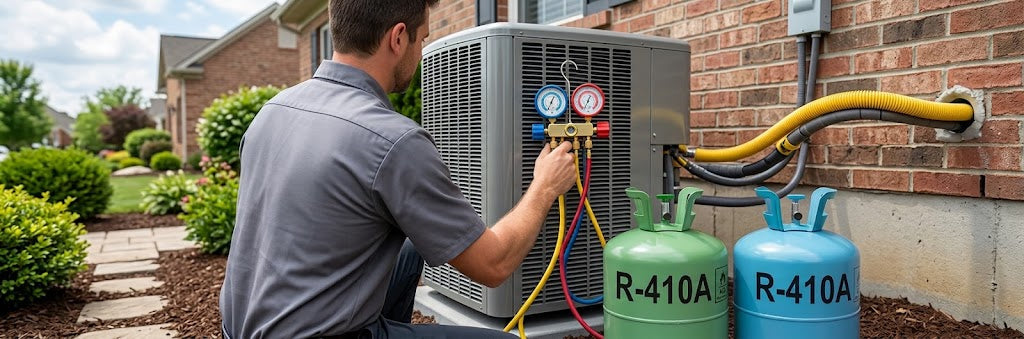
If you're shopping for a new air conditioner in 2026, you've probably noticed something new popping up in spec sheets and sales conversations: refrigerant type. For decades, R-410A was the standard refrigerant in nearly every residential AC system sold in the United States. That's changing, and it's changing fast. At The AC Outlet, we're fielding more questions about this shift than almost anything else this year — so let's break down what's actually happening, why it matters, and what it means for your next AC purchase.
What's Actually Happening to R-410A?
The short version: R-410A is being phased down under federal regulation, and it's being replaced by newer, lower-impact refrigerants across the industry.
This shift is being driven by the American Innovation and Manufacturing (AIM) Act, which directs the U.S. Environmental Protection Agency to reduce the production and consumption of hydrofluorocarbons (HFCs) — the family of refrigerants that includes R-410A. HFCs have a high global warming potential, meaning that even small leaks can have an outsized environmental impact compared to older refrigerants they replaced. The EPA's phase-down schedule calls for a steep reduction in HFC production over the next decade, and manufacturers have already shifted their engineering and production lines accordingly.
In practical terms, this means R-410A systems are being phased out of production, not banned from existing homes. If you already have an R-410A system, it will keep running, and R-410A will still be available for service and recharging for the foreseeable future (though likely at a rising price as supply tightens). But if you're buying a new system, R-410A units are quickly disappearing from manufacturer lineups in favor of next-generation alternatives.
Meet the Replacements: R-32 and R-454B
Two refrigerants are leading the transition: R-32 and R-454B. Both belong to a newer refrigerant class called A2Ls — mildly flammable, lower-GWP refrigerants that are seen as a middle ground between older HFCs and the more aggressively flammable A3 refrigerants used in some other regions.
R-454B has emerged as the primary replacement for R-410A in most U.S. residential systems. It has a significantly lower global warming potential and is designed as a near drop-in replacement in terms of system pressure and performance, which is part of why manufacturers gravitated toward it.
R-32 is also gaining traction, particularly in ductless mini-split and heat pump systems. It's a single-component refrigerant (unlike blended refrigerants such as R-410A and R-454B), which can make it easier to service, and it also carries a lower environmental impact than R-410A.
Both refrigerants are classified as mildly flammable (A2L), which means new systems using them require updated safety features — things like refrigerant leak detection sensors and specific ventilation requirements. This isn't something to be alarmed about; it's a well-understood engineering challenge, and manufacturers have built in the appropriate safeguards. But it's part of why new-generation systems look and function a little differently under the hood than the R-410A units you might be replacing.
Why This Matters When You're Buying a New System
Here's where it gets practical for homeowners:
1. Compatibility isn't optional. A2L refrigerant systems require components engineered specifically for them — compressors, line sets, and safety systems all need to match. You can't simply swap R-454B into an old R-410A unit, and vice versa. When you're comparing quotes for a new system, make sure the refrigerant type is clearly specified and that the whole system (not just the outdoor unit) is designed for it.
2. Pricing is shifting. As R-410A supply tightens and demand for new-refrigerant systems rises, pricing dynamics are shifting industry-wide. Some homeowners may see slightly different upfront costs for A2L systems compared to older units, but the reality is that R-410A equipment is becoming harder to find altogether, which is pushing the market toward the new standard regardless.
3. Contractor familiarity varies. Because this transition has moved quickly, not every installer has deep experience with A2L refrigerants yet. When evaluating a new system purchase, it's worth asking directly whether your contractor is trained and certified to handle the refrigerant type in the unit you're buying.
4. Long-term service considerations. If you buy a new R-410A system today (where still available), be aware that refrigerant availability and servicing costs may become less favorable over time as the industry fully transitions. Buying into the new refrigerant standard now can mean fewer headaches — and more serviceability — down the road.
This Overlaps With Another Big Shift: SEER2
The refrigerant transition isn't happening in isolation — it's arriving at the same time as updated SEER2 efficiency standards, which raised the minimum efficiency bar for new residential AC systems. Many manufacturers are using this moment to redesign product lines from the ground up, combining new refrigerants with higher-efficiency compressors, smarter controls, and improved coil designs.
The upshot for homeowners: a new AC system purchased today isn't just "a new refrigerant in an old design." In most cases, it's a meaningfully different piece of equipment — more efficient, more tightly engineered, and built around a different set of environmental and safety standards than systems from even five years ago.
What Should Homeowners Do Right Now?
If you're in the market for a new AC system, here's how to approach the refrigerant question with confidence:
- Ask what refrigerant the system uses, and confirm it's a complete, matched system (indoor and outdoor components engineered for the same refrigerant).
- Confirm your installer's certification for handling A2L refrigerants — this matters both for a safe installation and for future servicing.
- Don't assume "newer is more expensive." In many cases, new-refrigerant systems are priced competitively, especially as they become the standard rather than the exception.
- Think about the next 10–15 years. A system installed today will likely still be running well into the 2030s. Choosing a system built around current refrigerant standards means you won't be stuck with a unit that's increasingly expensive or difficult to service as R-410A supply continues to shrink.
- Ask about efficiency ratings alongside refrigerant type. Since many new systems combine refrigerant changes with SEER2-driven efficiency gains, it's worth understanding both what's in the system and how efficiently it runs.
The Bottom Line
The phase-out of R-410A isn't a distant, future concern — it's actively reshaping what's available on showroom floors and installation trucks right now. For homeowners considering a new AC system, this transition means paying closer attention to refrigerant type, contractor certification, and long-term serviceability, rather than just sticker price and tonnage.
At The AC Outlet, we've built our new-system recommendations around this shift — helping homeowners choose equipment that's not just efficient today, but well-positioned for the refrigerant and efficiency standards of the next decade. If you're weighing your options for a new AC system, understanding this transition is one of the most valuable things you can do before you buy.


