


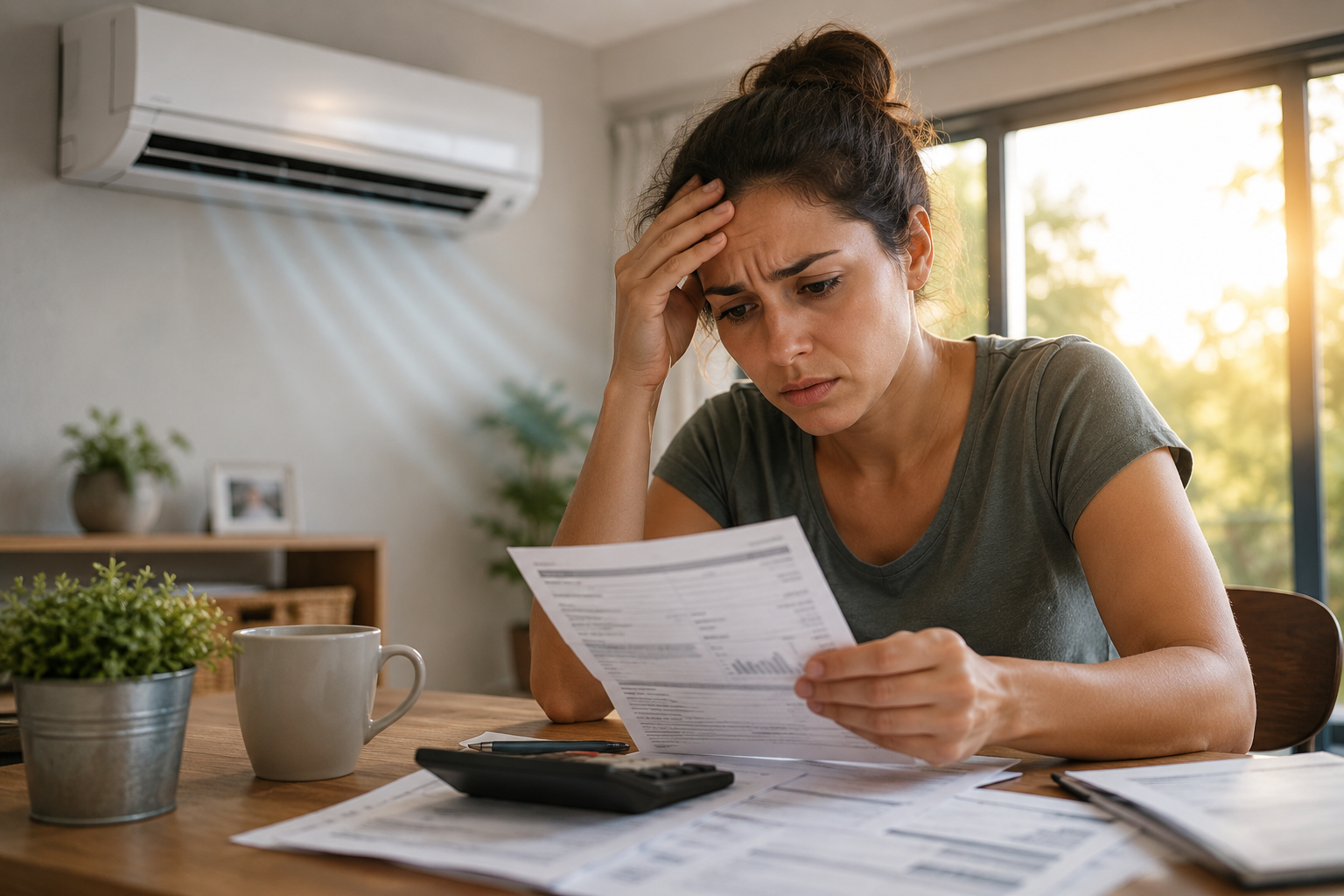
Every June, the same thing happens. The weather turns, the AC kicks on, and the electricity bill climbs to a number that makes you wince. You tell yourself it's just summer, it's unavoidable, everyone's bill goes up. And then you wonder why your neighbor — same size house, same neighborhood — seems to pay considerably less.
The spike isn't random. There are specific, identifiable reasons why some homes cost far more to cool than others, and most of them are fixable. Some fixes take an afternoon. Some are larger investments. All of them are more effective than simply turning the thermostat up and sweating through it.
Here's what's actually driving your summer bill — and what genuinely works to bring it down.
Why Summer Bills Spike: The Real Mechanics
Your electricity bill is a function of how hard your AC system works multiplied by how efficiently it converts electricity into cooling. Most summer bill spikes come from one of three places: the system is working harder than it should, it's doing so inefficiently, or both.
Understanding which applies to your home points you toward the right fixes — and stops you from spending money on solutions that won't move the needle.
Reason 1: The System Is Fighting a Building That Lets Heat In
An AC system doesn't cool a house in isolation. It's constantly competing against heat that conducts through the roof, radiates through windows, and infiltrates through gaps in the building envelope. The more heat enters the home, the harder and longer the system has to run to maintain the set temperature — and every extra hour of runtime shows up on the bill.
The biggest heat entry points in most homes are the attic and the windows. A poorly insulated attic allows heat from a 150-degree roof surface to radiate directly into the living space. West-facing windows with no shading allow direct afternoon sun to flood rooms with solar heat load at exactly the hottest part of the day.
What actually works:
Adding attic insulation to the recommended R-38 to R-60 level is one of the highest-ROI home improvements available specifically for cooling costs. In a home with inadequate attic insulation, this single change can reduce cooling costs by 15 to 25%. The payback period in high-cooling climates is often under five years.
Exterior shading for west-facing windows — awnings, exterior shutters, or deciduous trees positioned to block afternoon sun — reduces solar heat gain before it enters the glass. Interior window treatments like cellular shades with high solar heat gain rejection ratings help, but exterior solutions are more effective because they intercept the heat before it passes through the glass.
Reason 2: The System Is Running Longer Than It Needs To
Every hour your AC runs costs money. Anything that causes the system to run longer than necessary to maintain comfort directly increases the bill.
The most common culprit is a dirty air filter. A clogged filter restricts airflow through the system, reducing the volume of air the system can condition per hour. To make up for this, the system runs longer cycles. On a hot day, a severely restricted filter can add meaningful hours of runtime compared to a clean one — and that difference compounds across a full summer.
Dirty evaporator coils have a similar effect. The indoor coil is where the system actually pulls heat out of the air. When it's coated in a layer of dust and debris, its heat-absorbing efficiency drops, and the system runs longer to achieve the same cooling.
Duct leakage is another runtime multiplier. Department of Energy research finds that typical duct systems lose 20 to 30% of conditioned air through leaks into unconditioned attic and crawl spaces. If 25% of the cool air your system produces never reaches the living space, the system effectively has to run 33% longer to deliver the same amount of cooling.
What actually works:
Replacing the air filter monthly during summer — not quarterly — is free aside from the cost of the filter and is the simplest runtime reducer available.
Professional duct sealing, where a technician uses mastic sealant or metal tape to seal duct joints and connections, typically reduces duct leakage by 50 to 80% and is one of the most cost-effective professional services available for reducing cooling bills in homes with forced-air systems.
Professional coil cleaning during annual maintenance restores heat exchange efficiency and reduces runtime. It's a standard part of a proper HVAC tune-up.
Reason 3: The System Is Converting Electricity Inefficiently
SEER (Seasonal Energy Efficiency Ratio) measures how efficiently a condenser converts electricity into cooling. A 10 SEER unit uses roughly twice as much electricity to produce the same cooling as a 20 SEER unit. The efficiency gap is real, it's large, and it directly determines what you pay to run the system each month.
Most homes have AC equipment installed 10 to 20 years ago. Minimum efficiency standards at the time were significantly lower than current standards. A 10 or 12 SEER unit — which was entirely standard in the early 2000s — uses dramatically more electricity than the 16 to 18 SEER units available today at mid-range price points, let alone the 20+ SEER units at the premium end.
As condensers age, they also lose efficiency. A unit rated at 14 SEER when new may operate at the equivalent of 10 to 11 SEER by the time it's 12 to 15 years old, as the compressor wears and system performance declines. So the efficiency gap between an aging unit and a new one is even larger than the nameplate ratings suggest.
What actually works:
If your condenser is over 12 years old, calculating the operating cost difference between your current system and a new high-efficiency unit is worth doing seriously. In a home that runs AC heavily — six or more months per year in warm climates — the annual savings from replacing a 10 SEER unit with a 16 SEER unit can be $400 to $700 or more depending on electricity rates and usage. Over a 15-year lifespan, that's a significant offset against the replacement cost.
This isn't a case every homeowner will make — a relatively young system in a mild climate may not reach payback on efficiency grounds alone. But for an aging system in a hot climate with high electricity rates, efficiency-driven replacement is a legitimate financial calculation, not just a comfort upgrade.
Reason 4: The Thermostat Strategy Is Working Against You
Thermostat behavior has a larger effect on summer bills than most homeowners expect — both through the temperature setpoint and through how the system manages the difference between occupied and unoccupied periods.
Every degree the thermostat is set lower increases cooling costs by roughly 3%. Setting the thermostat at 72 instead of 76 costs approximately 12% more to maintain. This doesn't mean uncomfortable — it means that the temperature setpoint decision is worth making intentionally rather than defaulting to whatever feels right.
Running the system at full cooling during unoccupied hours — while everyone is at work or school — is a significant source of unnecessary cost. A home that cools from 80 to 74 degrees before occupants return uses far less energy than one that maintains 74 degrees continuously through the empty afternoon.
What actually works:
A programmable or smart thermostat that allows setback during unoccupied hours is one of the highest-return low-cost investments for reducing cooling bills. Setting the thermostat to allow the home to warm to 80 or 82 while unoccupied and beginning to cool an hour before people return can reduce cooling costs by 10 to 15% without any sacrifice in comfort.
Smart thermostats that learn occupancy patterns and adjust automatically have become inexpensive — many models are available for under $150 and pay for themselves in a single cooling season in high-use homes.
Using ceiling fans to allow a 4-degree higher thermostat setpoint while maintaining equivalent perceived comfort reduces runtime and electricity cost proportionally.
Reason 5: The System Is Oversized and Short-Cycling
This one is counterintuitive. An oversized AC system — one that's larger than the home's heat load actually requires — doesn't cool the home better. It cools it too quickly, then shuts off before it has run long enough to remove meaningful humidity from the air.
The result is a home that reaches the set temperature quickly but then swings — cooling down, shutting off, warming back up, then cycling on again repeatedly. Each startup draws a higher electrical load than steady-state running. High-cycle-count operation also accelerates wear on the compressor and other components.
An oversized system also fails at dehumidification — which, as discussed earlier, makes the home feel warmer than the temperature reading suggests, often causing occupants to lower the thermostat further and increase costs.
What actually works:
If your system was installed without a proper Manual J load calculation — which is common, particularly for replacement units simply matched to the previous system's tonnage — there's a chance it's oversized. Signs include very short cooling cycles, humidity problems despite adequate cooling, and comfort complaints even when the thermostat is set low.
A proper load calculation by a qualified HVAC technician can confirm whether your system is correctly sized. For a replacement scenario, insisting on a Manual J before accepting a quote is the right approach.
Reason 6: Rate Structure and Usage Timing
Electricity isn't always the same price per kilowatt-hour around the clock. Many utility providers use time-of-use pricing, where rates during peak demand periods — typically 2pm to 8pm on weekdays — are significantly higher than off-peak rates. In some markets, peak rates are two to three times the off-peak rate.
If your utility uses time-of-use pricing, running the AC at full capacity during peak hours is considerably more expensive per unit of cooling than running it during off-peak hours. Pre-cooling the home in the late morning before peak pricing begins — allowing the temperature to rise slightly during the peak window — can meaningfully reduce the bill without significant comfort impact.
Check your utility bill or provider's website to see whether time-of-use pricing applies to your account.
The Honest Bottom Line
Summer electricity bills don't spike because air conditioning is inherently expensive. They spike because most homes have accumulated a set of inefficiencies — in the building envelope, the equipment, the duct system, and the operational habits — that each add cost individually and compound together.
The fixes that work aren't complicated. Better filtration, thermostat management, and ceiling fan usage cost almost nothing and deliver immediate results. Attic insulation, duct sealing, and window shading are larger investments with meaningful long-term payback. And for homes with aging, inefficient equipment, replacing the condenser with a high-efficiency modern unit addresses the efficiency gap that no amount of behavioral change can fully close.
The goal isn't to cool less. It's to cool smarter.


