


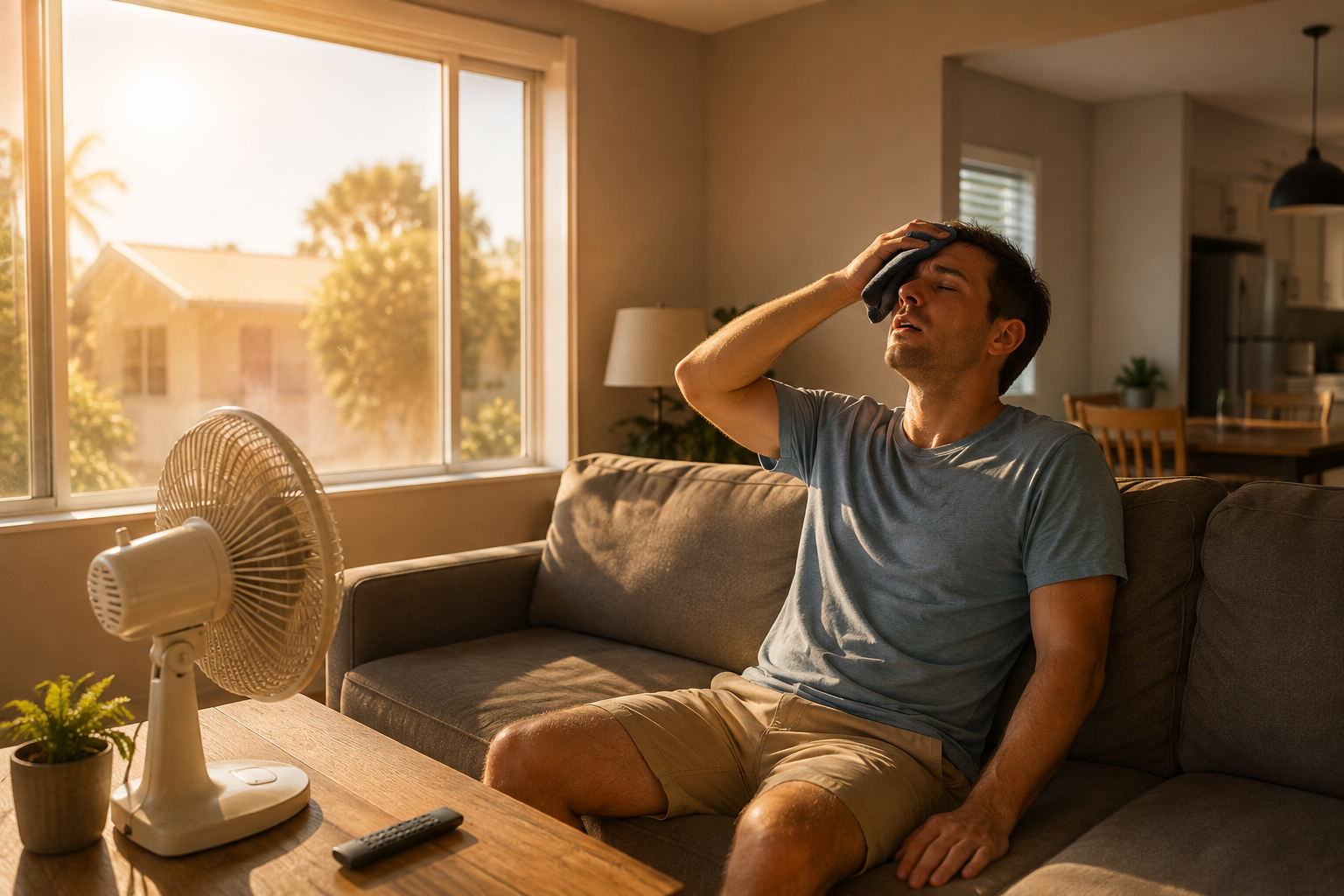
It happens every summer. The thermometer outside reads 88 degrees and yet stepping inside feels worse — stuffy, airless, and somehow hotter than the yard you just walked in from. You check the thermostat. The AC is running. And yet the house feels like it's retaining heat rather than releasing it.
This isn't your imagination. There are specific, well-understood reasons why a house can feel significantly hotter than outdoor air temperature — and most of them have nothing to do with how hard your AC is working. Understanding the causes is the first step toward actually fixing them.
The Difference Between Temperature and Heat
Before getting into causes, it helps to understand why "feels hotter" is often more accurate than what a thermometer reads.
Perceived heat is a combination of air temperature, radiant heat, humidity, and air movement. Your body doesn't just sense air temperature — it senses the combined effect of all four. A house at 80 degrees with high humidity, still air, and radiant heat from sun-baked walls will feel significantly hotter than 80 degrees outdoors in a breeze with lower humidity.
This is why fixing the temperature reading alone doesn't always fix the comfort problem. A house that reads 78 on the thermostat can still feel oppressive if the underlying causes are humidity, radiant heat, or inadequate air circulation. Addressing the right causes makes a bigger difference than simply setting the thermostat lower.
Cause 1: Your Roof and Attic Are Acting as a Heat Battery
This is the most common cause — and the most underestimated.
On a sunny summer day, a dark roof surface can reach 150 to 170 degrees Fahrenheit. That heat conducts through the roofing material into the attic space, where temperatures regularly exceed 130 to 150 degrees even on a moderately hot day. From there, the heat radiates downward through the ceiling into the living space below.
This process continues for hours after the sun goes down. The thermal mass of your roof and attic absorbs heat throughout the day and releases it slowly through the evening and into the night — which is why bedrooms on upper floors often feel unbearable even at 10pm when outdoor temperatures have dropped considerably.
Inadequate attic insulation is the primary amplifier of this effect. The Department of Energy recommends R-38 to R-60 of insulation in the attic for most US climate zones. Many homes, particularly older ones, have significantly less — sometimes as little as R-11. Without sufficient insulation, the heat radiating from the attic floor passes directly into the ceiling of the living space.
Attic ventilation matters too. A properly ventilated attic allows hot air to escape rather than accumulate. Ridge vents, soffit vents, and attic fans all contribute to keeping attic temperatures lower and reducing the heat transfer into the living space.
Cause 2: West-Facing Windows Are Overloading Your AC
Windows are the weakest thermal barrier in most homes. Standard double-pane glass has an insulating value (R-value) of roughly R-2 — compared to R-13 or higher for a well-insulated wall. On the thermal performance scale, windows are essentially holes in your walls.
West-facing windows are the most problematic in summer. While east-facing windows take direct sun in the morning when temperatures are lower, west-facing windows receive direct afternoon sun — exactly when outdoor temperatures are at their peak and the sun's angle is low enough to penetrate deep into the room.
The radiant heat load from afternoon sun through west windows can overwhelm a correctly sized AC system in the affected rooms. The thermostat in a central hallway might read 74 degrees while a west-facing bedroom with large windows is genuinely 82 or 83 in the afternoon.
Solutions range from the inexpensive to the structural: window films that reject solar heat while maintaining visibility, exterior shading structures, cellular blinds rated for solar heat rejection, or full window replacement with low-emissivity (low-e) glass. Of these, exterior shading — awnings, pergolas, or deciduous trees that provide summer shade — is the most effective because it stops the heat before it enters the glass rather than after.
Cause 3: Your Home Has Air Leaks Letting Hot Air Straight In
Building codes and construction practices have improved significantly over the past few decades, but most homes still have meaningful air infiltration — gaps and cracks that allow hot outdoor air to enter and conditioned air to escape.
Common infiltration points include:
Attic bypasses — gaps around plumbing pipes, electrical wires, and recessed light fixtures where they penetrate the ceiling into the attic. Hot attic air can pour directly into the living space through these openings. They're often invisible from below but clearly visible from the attic.
Door frames and window frames — weatherstripping compresses and hardens over time, losing its seal. Hold your hand near the edge of an exterior door on a hot day and you may feel warm air actively entering.
Electrical outlets on exterior walls — a surprisingly significant source of infiltration in older homes. Foam gaskets installed behind outlet covers are inexpensive and take seconds per outlet to install.
The gap between the top of interior walls and the ceiling — in balloon-frame construction common in homes built before the 1950s, wall cavities run continuously from the basement to the attic. Hot air from the attic can migrate down through these cavities into every floor of the house.
Air sealing is often more cost-effective per dollar than adding insulation, particularly in older homes. It reduces both the heat load your AC has to handle and the volume of humid outdoor air entering the home.
Cause 4: High Humidity Is Making Everything Feel Worse
Air temperature and perceived temperature diverge significantly as humidity rises. At 80 degrees and 80% relative humidity, most people feel as if the temperature is closer to 88 degrees. The heat index — the "feels like" temperature — accounts for this relationship.
Indoor humidity in summer comes from multiple sources: humid outdoor air infiltrating through gaps and opening doors, moisture from cooking and bathing that isn't adequately exhausted, and in some cases moisture migrating up from a crawl space or basement.
Your AC system removes some humidity as a byproduct of cooling — when warm humid air passes over the cold evaporator coil, moisture condenses out of the air, like condensation on a cold glass. But this dehumidification only happens when the system is actively running a full cooling cycle. A system that's oversized cools the space too quickly and shuts off before it runs long enough to remove meaningful moisture, leaving the air cool but still humid.
If your house feels clammy and heavy even when the temperature seems acceptable, humidity is likely a significant part of the problem. A standalone hygrometer (available for under $20) will tell you your indoor humidity level. Above 60% is uncomfortable and promotes mold growth. Above 70% is genuinely problematic.
Cause 5: Your AC System Isn't Keeping Up
Sometimes the answer is simply that the AC system isn't performing as it should.
An aging condenser loses capacity gradually over its lifespan. A system that was correctly sized and efficiently cooled the house when it was new may struggle with the same load as it ages and components wear. The symptom — house that won't cool properly — looks the same whether the cause is the building envelope or the equipment.
An undersized system has the same effect. If the original equipment was undersized for the home's heat load (which happens more often than it should), the system will run continuously without maintaining the set temperature during peak heat.
Dirty evaporator coils are another culprit. The indoor evaporator coil — inside the air handler — is where the actual heat exchange happens. If it's coated in dust and debris, its ability to absorb heat from the air passing over it is reduced, and the system's effective cooling capacity drops significantly. This is a professional service item, but it can make a dramatic difference in how well the system cools.
Duct leakage is often overlooked. If 20 to 30% of the cool air your system produces is escaping into unconditioned attic or crawl space before it reaches the living space — which is typical for many homes — the effective cooling delivered to the rooms is far less than the system is rated for.
Cause 6: Heat Is Being Generated Inside the Home
In summer, internal heat generation matters more than most people realise.
Incandescent and halogen bulbs convert a large percentage of their energy into heat rather than light. A room with six 60-watt incandescent bulbs is generating 360 watts of continuous heat. LED replacement bulbs generating the same light output produce a fraction of the heat.
Large appliances — ovens, dishwashers, clothes dryers — generate significant heat loads when operated during the hottest part of the day. Shifting these activities to early morning or evening reduces the peak heat load the AC has to manage in the afternoon.
Electronics on standby generate steady low-level heat. In a home with multiple televisions, gaming systems, cable boxes, and computers, the combined standby heat load is not trivial.
Putting It Together
In most homes that feel hotter than outside, the cause isn't a single issue — it's a combination. Inadequate attic insulation allows radiant heat to conduct into the living space. West-facing windows add direct solar heat gain in the afternoon. Air leaks allow humid outdoor air to enter continuously. The AC system, working against all of these loads simultaneously, can't keep up.
The good news is that each of these causes has a practical fix. Some of them — weatherstripping, window coverings, LED bulb replacement — cost almost nothing. Others — attic insulation, air sealing — are significant investments that pay back in reduced energy costs over time.
And if the AC system itself is part of the problem — aging, undersized, or operating with dirty coils and leaky ducts — addressing the building envelope first makes the equipment more effective, and replacing aging equipment with a properly sized, efficient system makes everything else work better.
A house that stays genuinely comfortable in summer isn't the result of running the AC harder. It's the result of understanding all the forces working against it — and addressing them systematically.


