


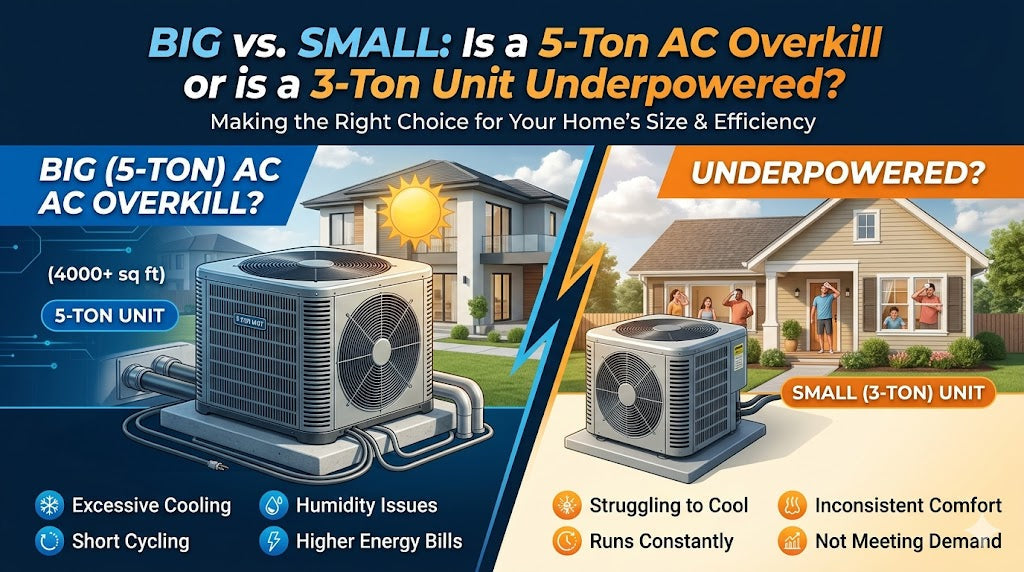
When it comes to keeping your home cool, many people assume that bigger is always better. After all, if your old AC fails during a 100°F heatwave, it’s tempting to jump straight to a 5-Ton unit to make sure your home stays ice-cold. But in reality, oversizing your air conditioner can be just as problematic as installing a unit that’s too small.
Air conditioners are measured in tons, which indicate their cooling capacity rather than weight. One ton equals 12,000 BTUs per hour, and choosing the wrong size can have far-reaching consequences—short-cycling, poor humidity control, uneven cooling, and higher energy bills. At The AC Outlet, we’ve seen firsthand how the “just go bigger” approach often backfires.
Why a 5-Ton AC Can Be Too Much
Imagine a home that only needs a 3 or 3.5-Ton system. Installing a 5-Ton unit may cool your space quickly, but this speed comes with hidden costs. The system will turn on and off frequently—a phenomenon known as short-cycling—which stresses the compressor and shortens the unit’s lifespan.
Oversized units also struggle with humidity. Air conditioners don’t just lower temperature; they remove moisture from the air. A 5-Ton system cools so fast that it often shuts off before it has the chance to fully dehumidify your home, leaving rooms that feel cold yet clammy. And if your ductwork was designed for a smaller unit, pushing all that extra air through can create loud whistling noises, vibrations, and even long-term damage.
When a 3-Ton Unit Isn’t Enough
On the other side of the spectrum, installing a 3-Ton unit in a home that truly requires 4 or 5 tons leads to constant frustration. The system struggles to keep up on hot days, running almost continuously without ever reaching the desired temperature. This non-stop operation not only results in skyrocketing energy bills, but also leaves far-away rooms, like upstairs bedrooms, warmer than the rest of the house.
The Middle Ground: 3.5-Ton and 4-Ton Systems
For many homes, the solution lies somewhere in between. A 3.5-Ton unit often hits the sweet spot for properties between 1,800 and 2,200 square feet, providing enough cooling power without the extreme airflow demands of a 5-Ton system. Similarly, a 4-Ton system is ideal for homes around 2,200 to 2,500 square feet or those with high ceilings or significant sun exposure. These mid-range units strike the right balance between efficiency, comfort, and cost.
Other factors influence the decision too. Homes with vaulted ceilings or large west-facing windows experience more heat gain and may require slightly larger systems. Conversely, if your home has upgraded insulation and energy-efficient windows, you might get away with a smaller, more efficient unit without sacrificing comfort.
Efficiency Matters
Modern high-capacity units also follow stricter efficiency standards. Newer refrigerants like R-454B and R-32 improve heat transfer, while SEER2-rated systems—ideally 16 or higher—help reduce energy costs by 15–20% compared to older models. Choosing the right size, combined with modern technology, ensures that your AC works efficiently year-round.
Conclusion
The best AC for your home isn’t always the biggest. Oversized units may seem powerful, but they can waste energy, cause discomfort, and wear out faster. Undersized units, meanwhile, struggle to keep your home consistently cool. At The AC Outlet, we carry the full range of sizes—from 3-Ton condensers to 5-Ton powerhouses—so you can choose a system that matches your home’s exact needs, ensuring maximum comfort, efficiency, and longevity.
Whether you’re upgrading an older system or installing a new unit in a large home, the right size makes all the difference. A properly sized AC system keeps your home comfortable, quiet, and energy-efficient all summer long.


