


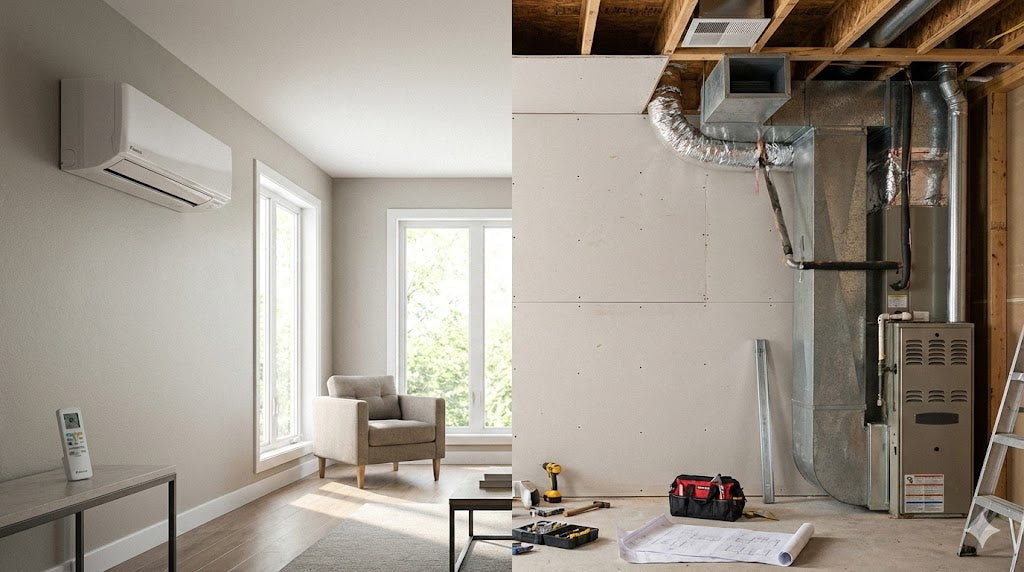
Walk into any HVAC conversation today and one comparison comes up more than almost any other: Daikin vs. traditional HVAC systems. On one side you have Daikin — a Japanese-engineered brand synonymous with inverter-driven ductless technology and ultra-high efficiency. On the other side you have the conventional ducted central air systems that have cooled and heated American homes for decades, built by brands like Goodman, Rheem/Ruud, York, and Airquest.
Both systems work. Both have genuine advantages. And depending on your home, your budget, and your long-term goals, one will almost certainly serve you better than the other. At The AC Outlet — America's trusted online source for wholesale HVAC equipment for over 15 years — we help homeowners and contractors make exactly this kind of decision every day. So let's cut through the marketing noise and give you the honest, side-by-side breakdown you actually need.
What Is a Traditional HVAC System?
A traditional HVAC system — also called a central air system or ducted system — consists of an outdoor condenser unit paired with an indoor air handler or furnace, connected by a network of ductwork that distributes conditioned air throughout the home via vents and registers.
This is the system most American homeowners are already familiar with. You set the thermostat, the compressor kicks on, refrigerant cycles between the outdoor condenser and the indoor coil, and cooled or heated air is pushed through the ducts into every room of the house simultaneously.
Traditional systems are available in a wide range of tonnages — from 1.5 ton all the way up to 5 ton — and in multiple efficiency tiers measured by SEER2 ratings ranging from the federally mandated minimum of 13.4 SEER2 up to 19.0 SEER2 and beyond for premium variable speed models. They run on modern refrigerants including R-454B and R-32, and they remain by far the most commonly installed residential cooling and heating solution in the United States.
What Is a Daikin System?
Daikin is a Japanese HVAC manufacturer and one of the largest air conditioning companies in the world by revenue. While Daikin does manufacture traditional ducted systems — including a line of products sold in the United States under the Daikin brand — the company is best known in the residential market for its ductless mini-split systems, which operate on inverter-driven variable speed compressor technology.
A Daikin ductless mini-split consists of a compact outdoor compressor unit connected to one or more indoor wall-mounted air handlers via a small refrigerant line set — no ductwork required. Each indoor unit operates independently, allowing for zone-by-zone temperature control throughout the home.
Daikin's flagship residential mini-split systems carry some of the highest efficiency ratings available — with select models reaching SEER2 ratings above 20 — and they are frequently cited for whisper-quiet operation and precision comfort control.
Daikin vs. Traditional HVAC: The Core Differences
1. Ductwork Requirements
This is the most fundamental difference between the two system types and often the deciding factor for homeowners.
Traditional HVAC systems require ductwork. If your home already has a functioning duct system, a traditional central air replacement is almost always the most cost-effective path forward. The infrastructure is already there — you're simply swapping the equipment.
Daikin mini-splits require no ductwork. This makes them an attractive option for homes without existing ducts — older homes, historic properties, room additions, garages, sunrooms, or any space where running ductwork would be prohibitively expensive or structurally impractical.
The verdict: if your home already has ducts in good condition, a traditional system almost always wins on installation cost. If you're working without ducts, Daikin's ductless technology becomes a far more compelling option.
2. Energy Efficiency
Both system types have made enormous efficiency gains in recent years, but ductless mini-splits — including Daikin's lineup — generally hold an efficiency edge for a specific reason: duct loss.
Studies by the U.S. Department of Energy estimate that 20 to 30% of conditioned air is lost through leaky or poorly insulated ductwork in a typical American home. That means a traditionally ducted system rated at 16 SEER2 may effectively deliver only 12–13 SEER2 worth of conditioning to your living space once duct losses are factored in.
A ductless Daikin system delivers conditioned air directly to the room with no duct losses whatsoever — which is a significant real-world efficiency advantage.
That said, modern traditional systems at 15.2, 16.0, and 17.2 SEER2 — like the Rheem/Ruud Endeavor two-stage and Goodman GLXT variable speed condensers available at The AC Outlet — are closing the gap considerably. In a well-sealed, properly insulated duct system, the efficiency difference becomes much smaller in practice.
The verdict: Daikin ductless wins on raw efficiency, especially in homes with duct loss issues. Modern high-SEER2 traditional systems are competitive in homes with tight, well-maintained ductwork.
3. Upfront Cost
Here is where traditional HVAC systems hold a clear and significant advantage for most homeowners.
A quality 3-ton traditional AC condenser from a brand like Goodman, Airquest, or Rheem/Ruud purchased at wholesale HVAC pricing from The AC Outlet can run anywhere from $1,600 to $3,500 depending on efficiency tier — with installation labor typically adding $1,500 to $3,000 in most markets for a straightforward replacement.
A Daikin multi-zone mini-split system capable of conditioning a comparable square footage can cost $3,000 to $8,000 or more for equipment alone, with installation labor often running higher due to the specialized nature of the work and the need to mount multiple indoor units.
For homeowners replacing an existing central air system with existing ductwork, the upfront cost of going traditional is almost always substantially lower.
The verdict: traditional HVAC wins decisively on upfront cost for homes with existing ductwork. The gap narrows — and can even reverse — in new construction or homes requiring duct installation from scratch.
4. Zoning and Comfort Control
This is Daikin's strongest suit. Ductless mini-split systems offer true room-by-room zoning — each indoor unit can be set to a different temperature independently, allowing different family members to maintain their preferred comfort level in different areas of the home simultaneously.
Traditional ducted systems can achieve zoning through the addition of zone dampers and multiple thermostats, but this adds significant cost and mechanical complexity to the system. Most standard traditional installations operate as single-zone systems — one thermostat, one temperature for the whole house.
If you have rooms that are chronically too hot or too cold, a home office that needs cooling when the rest of the house doesn't, or family members with significantly different temperature preferences, Daikin's zoning capability is a genuine quality-of-life advantage.
The verdict: Daikin ductless wins on zoning flexibility. Traditional systems can achieve zoning but require additional investment.
5. Installation Complexity and Timeline
A traditional HVAC replacement in a home with existing ductwork is one of the most straightforward installations in the industry. An experienced HVAC technician can typically complete a full condenser and air handler swap in a single day — sometimes in just a few hours for a clean, accessible installation.
Daikin mini-split installations vary widely in complexity. A single-zone system in a room addition or garage can be surprisingly quick. A whole-home multi-zone system with five or six indoor units, multiple refrigerant line sets, and a complex wiring layout can take two to three days and requires a technician with specific mini-split installation experience.
The verdict: traditional HVAC wins on installation simplicity and speed, particularly for replacement projects.
6. Heating Capability
Both system types can provide heating as well as cooling — but how they do it differs significantly.
Traditional systems in a split system configuration typically pair with a gas furnace or electric air handler with heat strips for heating. In climates with cold winters, a gas furnace paired with a central AC condenser remains one of the most cost-effective whole-home comfort solutions available.
Daikin mini-splits operate as heat pumps — extracting heat from outdoor air and moving it indoors during winter. Modern Daikin cold-climate heat pump models can operate efficiently in outdoor temperatures as low as -13°F, making them viable in regions that were historically too cold for heat pump technology.
In mild to moderate climates, a Daikin heat pump mini-split can provide both cooling and heating from a single system with exceptional efficiency. In severe cold climates, a traditional ducted system paired with a gas furnace often remains the more practical and cost-effective heating solution.
The verdict: it depends on your climate. Mild climates favor Daikin heat pump efficiency. Cold climates often favor traditional gas heating paired with central AC.
7. Maintenance and Longevity
Traditional HVAC systems have a well-established maintenance routine that most HVAC technicians can service anywhere in the country. Annual tune-ups, filter changes, coil cleaning, and refrigerant checks are standard practice. With proper maintenance, a quality traditional system from brands like Goodman or Rheem/Ruud can deliver 15 to 20 years of reliable service.
Daikin mini-splits require regular cleaning of the indoor unit filters — which homeowners can typically handle themselves — plus periodic professional service of the refrigerant circuit and outdoor unit. Daikin's inverter compressors are engineered for longevity, and the brand is well regarded for durability. However, finding technicians experienced with mini-split service can be more challenging in rural markets than finding traditional HVAC service providers.
The verdict: roughly equal in longevity with proper maintenance. Traditional systems have a broader service network in most U.S. markets.
Who Should Choose a Traditional HVAC System?
A traditional ducted system from brands like Goodman, Airquest, Rheem/Ruud, York, or TuttoKool — purchased at wholesale HVAC pricing from The AC Outlet — is almost certainly the right choice if:
-
Your home already has existing ductwork in good condition
-
You're replacing an aging central air system on a defined budget
-
You want the lowest possible equipment and installation cost
-
You live in a cold climate and heat primarily with a gas furnace
-
You need to cool and heat the entire home from a single system
-
You want straightforward access to local HVAC service technicians
Who Should Consider a Daikin Ductless System?
A Daikin mini-split system makes the most sense if:
-
Your home has no existing ductwork and installation would be costly or impractical
-
You're conditioning a room addition, garage, sunroom, or outbuilding
-
You want true room-by-room zoning without the complexity of a duct damper system
-
You live in a mild climate and want a single system for both heating and cooling
-
Maximum energy efficiency is your primary priority and budget allows for the premium
-
You're working on new construction where duct routing is not yet established
Can You Find Daikin at The AC Outlet?
The AC Outlet specializes in wholesale HVAC equipment from the industry's leading traditional system brands — including Goodman, Airquest, Rheem/Ruud, Revolv, York, and TuttoKool — across the full range of tonnages from 1.5 to 5 tons and SEER2 ratings from 13.4 to 19.0. Our inventory covers single-stage, two-stage, and variable speed inverter condensers running on next-generation R-454B and R-32 refrigerants.
If you've evaluated both system types and determined that a traditional ducted system is the right fit for your home — which it is for the vast majority of American homeowners replacing existing equipment — The AC Outlet gives you direct access to wholesale pricing that puts premium equipment within reach of any budget.
Our 110% Price Match Guarantee, 0% APR Affirm financing, and 8,858+ verified 5-star reviews make The AC Outlet the smartest place to buy your next HVAC system online.
Daikin vs. Traditional HVAC
There is no universal winner in the Daikin vs. traditional HVAC debate — the right answer depends entirely on your home's specific circumstances. But for most American homeowners dealing with an aging central air system and existing ductwork, a high-efficiency traditional condenser from a trusted brand purchased at wholesale pricing is the most practical, cost-effective, and serviceable solution on the market today.
If your situation calls for ductless technology — new construction, room additions, or whole-home zoning — Daikin's mini-split systems represent world-class engineering worth the premium investment.
The key is knowing which category you fall into before you spend a dollar.


