


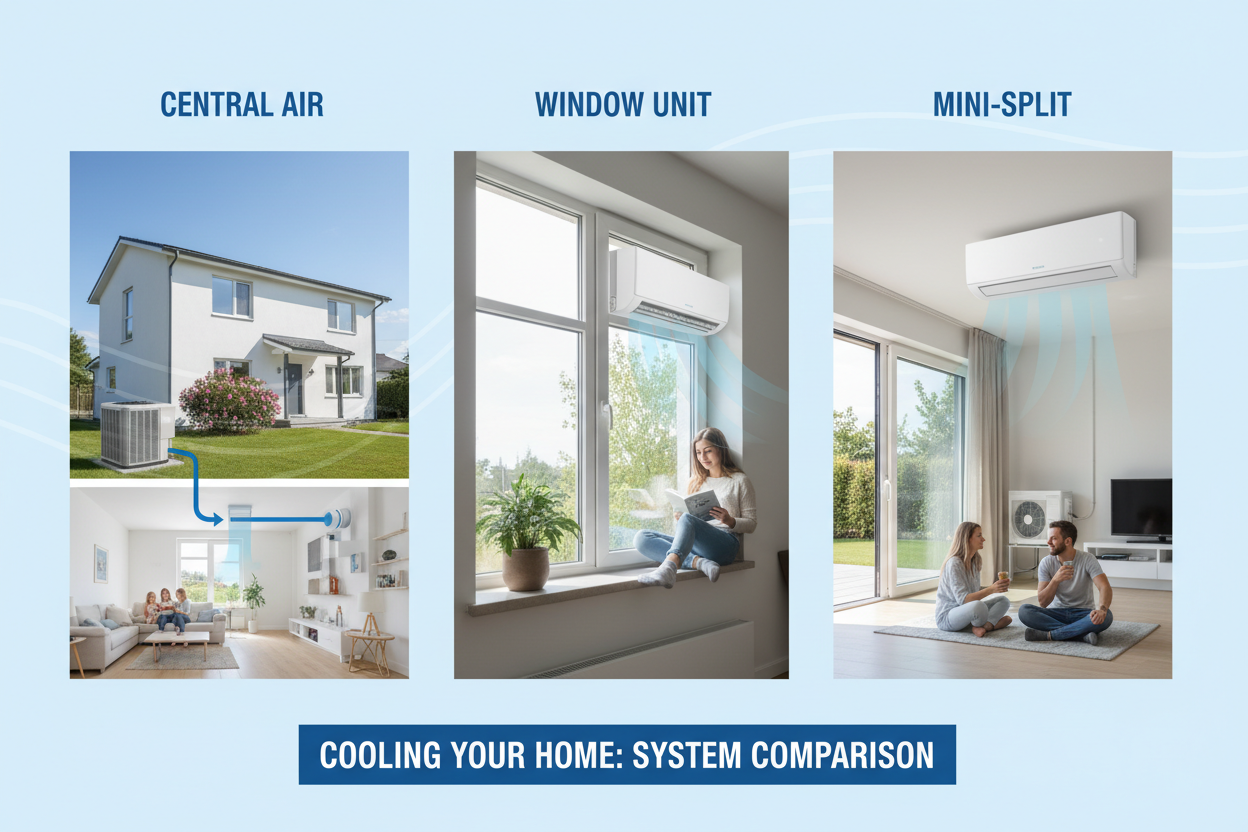
Shopping for air conditioning in the summer means you'll run into three main options: central air, window units, and mini-splits. Each one works. Each one cools. But they're built for different homes, different budgets, and different situations — and picking the wrong type means spending more money for a result that still leaves you uncomfortable.
This guide cuts through the noise. We break down exactly how each system works, what it costs, who it's built for, and where it falls short — so you can walk into your purchase with full confidence.
The Three Types of Home Air Conditioning: A Quick Overview
Before going deep, here's the 30-second version:
- Central air conditioning uses a condenser outside and an air handler inside, connected by ductwork to cool your entire home from one system.
- Window units are self-contained air conditioners that mount in a window frame, cooling one room at a time.
- Mini-splits (also called ductless systems) use an outdoor compressor connected to one or more indoor wall-mounted heads — no ducts required, but professional installation needed.
Each has a completely different cost profile, installation requirement, and ideal use case. Let's break them down.
Central Air Conditioning: Best for Whole-Home Cooling
How It Works
A central AC system has two main components: an outdoor condenser unit that houses the compressor and condenser coil, and an indoor air handler (or furnace with an evaporator coil) connected to a network of ducts that distribute cooled air throughout every room in the house. One thermostat controls the whole system.
What It Costs
Equipment: $800 – $3,500+, depending on tonnage and efficiency rating (SEER) Installation: $1,500 – $5,000+ (labor, refrigerant, electrical connections).
Total installed cost: $2,500 – $8,000+ for most homes
If your home already has ductwork from an older system, replacement costs drop significantly — you're primarily paying for the new condenser and air handler rather than building out an entire duct system from scratch.
Efficiency
Central AC efficiency is rated by SEER (Seasonal Energy Efficiency Ratio). The federal minimum is 14 SEER in most US regions. Modern high-efficiency units run 18–26 SEER. Higher SEER means lower monthly operating costs, but a higher upfront equipment price. For most homeowners replacing a 10–12 SEER system, upgrading to a 16–18 SEER condenser pays for the difference in electricity savings within a few seasons.
Pros
- Cools the entire home uniformly from a single system
- Works through existing ductwork — no visible indoor equipment
- Best long-term value for homes over 1,500 sq ft
- Can be combined with a furnace for year-round HVAC
- One thermostat, one system to maintain
- Higher resale value impact on the home
Cons
- The highest upfront cost of the three options
- Requires professional installation — not a DIY project
- Needs existing or new ductwork (costly to add if not present)
- Cools the whole home whether you need it or not — less flexible for partial use
- Older duct systems can leak 20–30% of conditioned air before it reaches the rooms
Central Air Is Right for You If:
- You own a home 1,200 sq ft or larger
- You already have ductwork in place
- You want whole-home cooling on a single thermostat
- You're replacing an aging system (10+ years old)
- You're in a hot climate where AC runs 4–6 months a year
Shop Central Air Condensers at The AC Outlet → Browse by tonnage:
Window Air Conditioners: Best for Single-Room Cooling on a Budget
How It Works
A window unit is a completely self-contained system — compressor, evaporator coil, condenser coil, and fan all live inside a single box that mounts in a window frame. Warm room air passes over the evaporator coil inside, cooled air blows back into the room, and heat is exhausted outside through the rear of the unit. No ductwork. No refrigerant lines. Plug it in and it runs.
What It Costs
Equipment: $150 – $700 depending on BTU capacity and features.
Installation: None — DIY installation takes 20–30 minutes
Operating cost: Higher per BTU than central or mini-split, but only runs when you need it
Efficiency
Window units are rated by EER (Energy Efficiency Ratio) rather than SEER, a single-point efficiency measurement rather than seasonal. Look for Energy Star certified models with an EER of 12 or higher for meaningful savings. Because you're only cooling one room, the overall operating cost can actually be lower than running a central system for a space you only occupy part of the day.
Pros
- Lowest upfront cost of all three options
- No installation cost — truly DIY
- Immediate cooling — buy today, installed tonight
- Only cool occupied rooms — efficient for part-time use
- Portable (sort of) — can be removed and stored in winter
- No HVAC professional required
Cons
- Cools one room only — multiple units needed for whole-home coverage
- Blocks the window it occupies — reduces light and view
- Noisier than mini-splits or central systems
- Less efficient per BTU at whole-home scale
- Visible and less aesthetically appealing
- Not suitable for casement or sliding windows without adapters
- Removes the ability to use that window for ventilation
Window Units Are Right for You If:
- You rent your home or apartment (landlord won't allow permanent installation)
- You only need to cool one or two specific rooms
- Budget is the primary driver
- You're cooling a vacation home, garage workspace, or supplemental space
- You need a fast, same-day solution before a heat wave hits
Mini-Split Systems: Best for Efficient, Flexible, Ductless Cooling
How It Works
A mini-split system — also called a ductless or split system — separates the two components of AC: the outdoor compressor/condenser unit sits outside your home, and one or more indoor air handlers (wall-mounted heads) are installed on interior walls. Refrigerant lines run through a small hole in the wall connecting them. No ductwork. No window obstruction.
Multi-zone mini-splits add even more flexibility — one outdoor unit can power 2, 3, or 4 indoor heads in different rooms, each controlled independently.
What It Costs
Single-zone equipment: $700 – $2,500.
Multi-zone equipment: $1,500 – $5,000+
Installation: $500 – $2,000 per zone (electrical, refrigerant, mounting)
Total installed cost: $1,500 – $5,000+ for a single zone, more for multi-zone
Mini-splits cost more to install than window units but considerably less than adding new ductwork for central air in a home that doesn't have it.
Efficiency
Mini-splits are the most energy-efficient option of the three. Most modern mini-split systems run 18–30+ SEER, and many include an inverter-driven compressor that varies its speed based on demand rather than cycling fully on and off. This means they maintain more consistent temperatures, dehumidify better, and use less electricity per hour of operation than either window units or many central systems.
Most mini-splits also function as heat pumps, providing both heating and cooling — making them a true year-round HVAC system, not just a summer appliance.
Pros
- Highest efficiency of the three options — SEER ratings often 20+
- No ductwork required — ideal for additions, older homes, and renovations
- Quiet operation — indoor heads typically run at 19–26 dB on low
- Zone control — cool only the rooms you're using
- Doubles as a heat pump for year-round comfort
- No window obstruction
- Cleaner air quality — most include multi-stage filtration
Cons
- Higher upfront cost than window units
- Requires professional installation — refrigerant handling needs certification
- Indoor wall heads are visible (though sleek)
- Wall penetration required for refrigerant lines
- Multi-zone systems require planning to size correctly
- Not always the right call for large homes where central air is more cost-effective
Mini-Splits Are Right for You If:
- Your home has no existing ductwork (older homes, additions, garages)
- You want room-by-room temperature control
- Energy efficiency and low operating costs are priorities
- You need both heating and cooling in one system
- You're cooling a sunroom, basement, converted garage, or home addition
- You want quiet operation in a bedroom or home office
Side-by-Side Comparison: Central AC vs Window Unit vs Mini-Split
| Central Air | Window Unit | Mini-Split | |
|---|---|---|---|
| Best for | Whole home | Single room | Room or multi-zone |
| Upfront cost | $2,500 – $8,000+ | $150 – $700 | $1,500 – $5,000+ |
| Installation | Professional only | DIY | Professional only |
| Efficiency (SEER) | 14 – 26 | 8 – 12 (EER) | 18 – 30+ |
| Ductwork needed | Yes | No | No |
| Noise level | Low (central duct) | Moderate–High | Very Low |
| Heats too? | With heat pump/furnace | No | Yes (heat pump) |
| Zone control | With add-ons | N/A | Yes (multi-zone) |
| Ideal home size | 1,200 sq ft+ | Any (per room) | Any (per zone) |
| Aesthetic | Hidden in walls | Visible in window | Wall-mounted head |
Which One Should You Actually Buy? A Decision Guide
Still not sure? Run through this quick decision tree:
Do you own your home and have existing ductwork? → Central air replacement is almost always the most cost-effective path for whole-home cooling. Shop condensers →
Do you rent, or only need to cool 1–2 rooms? → Window units are the fastest, most affordable solution. Shop window ACs →
Do you own your home but have no ductwork — or are you adding a room or renovation? → Mini-split is the clear winner. You get efficiency, quiet operation, and heating without the $10,000+ cost of adding ductwork. Shop mini-splits →
Do you want the most energy-efficient option regardless of home type? → Mini-splits win on efficiency. High-SEER mini-splits consistently outperform both window units and standard central AC on operating costs per BTU.
Do you need cooling fast, this week? → Window units can be purchased and installed the same day. Mini-splits and central systems require professional scheduling.
Do you want one system that handles both summer cooling and winter heating? → Mini-splits (heat pump models) and central AC with a gas or heat pump furnace are your two paths. Most mini-splits sold today include heat pump function at no extra cost.
How to Save Money No Matter Which System You Choose
Regardless of which type you go with, these habits lower your operating cost every month:
Right-size the equipment. Oversized units short-cycle and leave humidity behind. Undersized units run constantly and never fully catch up. Use our AC sizing guide to find your correct BTU range before you buy.
Choose Energy Star. Energy Star certified AC products use 10–15% less energy than standard models — that adds up to real dollars across a summer.
Seal and insulate first. No AC system performs well in a leaky, poorly insulated space. Adding weatherstripping to doors and windows before you buy reduces the BTU load your system needs to handle.
Use programmable or smart thermostats. Scheduling setbacks when the home is unoccupied reduces runtime by 10–15% with zero comfort sacrifice.
Keep the outdoor unit clear. Whether it's a window unit's rear vents or a central/mini-split condenser, restricted airflow around the outdoor section reduces efficiency and shortens equipment life.
Frequently Asked Questions
Is a mini-split better than central air? It depends entirely on your home. Mini-splits are more efficient and flexible, especially without ductwork. But central air is more cost-effective for large homes that already have ducts, and provides more seamless whole-home coverage.
Can a window AC cool an entire house? Technically possible with multiple units, but not practical or efficient. Multiple window units add up in cost quickly, and the noise and aesthetic downsides multiply. A mini-split or central system is the right answer for whole-home coverage.
How long does each type of AC system last? Window units: 8–12 years. Mini-splits: 15–20 years. Central air condensers: 12–20 years. Proper maintenance (filter cleaning, annual service) significantly extends lifespan on all three.
Do mini-splits work in extreme heat? Yes. Modern mini-splits are rated to operate in outdoor temperatures up to 115°F and down to -13°F for heat pump operation. Their performance holds up better in extreme conditions than older central systems without variable-speed compressors.
What is the cheapest way to cool a home? If budget is the only driver: window units have the lowest upfront cost. But if you're looking at 5+ years of operation, a high-SEER mini-split often has a lower total cost of ownership because of dramatically lower monthly electricity bills.
Does central air add value to a home? Yes. Central air conditioning consistently ranks as one of the top home improvements for resale value in most US markets, particularly in warm-climate states.
Ready to Shop? Find the Right System at The AC Outlet
The AC Outlet carries a full lineup of all three system types — from budget-friendly window units to high-efficiency central condensers and complete mini-split systems. Shop by system type or size and get the right equipment shipped fast before summer peaks.
Beat the summer heat the right way. Shop air conditioners, mini-splits, and central AC systems at The AC Outlet.


