


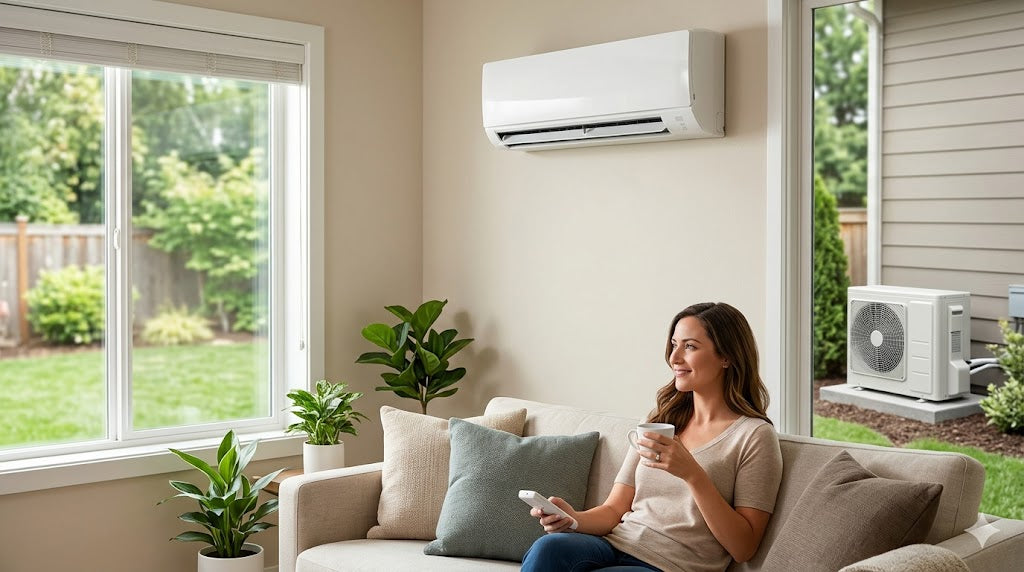
It happens to almost every homeowner eventually. You open your July or August utility bill, stare at the number, and think — there has to be a better way. Your central air system is running constantly, your rooms still feel uneven, and the cost of staying comfortable keeps climbing year after year.
There is a better way. And for a growing number of American homeowners, contractors, and builders, that better way is a mini-split air conditioning and heating system.
Mini-splits have gone from a niche product associated almost exclusively with Japanese and European markets to one of the fastest-growing segments of the residential HVAC industry in the United States — and the primary reason is simple: they save energy in ways that traditional ducted systems fundamentally cannot match. At The AC Outlet — America's trusted source for wholesale HVAC equipment for over 15 years — we've watched this technology transform from an alternative option into a mainstream comfort solution that deserves serious consideration from every homeowner evaluating their next HVAC investment.
Here's the complete, honest breakdown of why mini-splits are the ultimate energy-saving solution — and what you need to know before you buy.
The Core Problem With Traditional Ducted Systems: Duct Loss
To understand why mini-splits save so much energy, you first need to understand the single biggest energy efficiency problem built into virtually every traditional central air system in America: duct loss.
The U.S. Department of Energy estimates that the average American home loses 20 to 30% of conditioned air through leaky, poorly insulated, or improperly designed ductwork before that air ever reaches a living space. In older homes with aging duct systems, that number can climb even higher.
Think about what that means in practical terms. You're paying to cool or heat 100% of the air your system produces — but only 70 to 80% of it is actually doing useful work in your home. The rest is conditioning your attic, your crawl space, your wall cavities, and the great outdoors. Every month, every season, every year.
A ductless mini-split system eliminates this problem entirely. Conditioned air is delivered directly from the indoor air handler into the living space — no ductwork, no leakage, no waste. Every BTU your system produces goes exactly where you want it to go. That fundamental architectural difference is the foundation of the mini-split's energy efficiency advantage, and it explains why a mini-split rated at a given SEER2 level consistently outperforms a ducted system with the same rating in real-world operation.
Inverter Technology: The Engine Behind the Efficiency
Beyond the duct loss advantage, the second major reason mini-splits save so much energy is the technology inside the compressor itself: inverter-driven variable speed operation.
To understand why this matters, consider how a traditional single-stage air conditioner compressor works. It has exactly two operating states: full on or completely off. When your home needs cooling, the compressor fires up at 100% capacity. When the thermostat is satisfied, it shuts down completely. Then it starts again. Then it stops. Over and over, all day long.
This constant start-stop cycling is mechanically inefficient for two reasons. First, compressor startups consume significantly more electrical current than sustained operation — similar to how a car engine uses more fuel accelerating from a stop than maintaining highway speed. Second, because the system always runs at full blast when it runs at all, it frequently overshoots the target temperature, cools the space too quickly, shuts off, and then allows temperatures to drift back up before cycling on again — creating the uneven comfort that many homeowners experience as hot and cold swings throughout the day.
Inverter technology works completely differently. An inverter-driven compressor doesn't have an on/off switch — it has a continuous speed range. Using sophisticated electronic controls, the inverter modulates compressor speed in real time to match the precise cooling or heating demand of the space at any given moment. When the outdoor temperature is brutal and your home needs maximum cooling, the compressor ramps up. As conditions stabilize and the target temperature is approached, the compressor slows down — sometimes to as little as 10 to 20% of its maximum capacity — maintaining comfort with minimal energy consumption rather than cycling off entirely.
The result is a system that runs longer at lower speeds rather than shorter at full blast — and that operating profile is dramatically more energy efficient. Studies consistently show that inverter-driven mini-split systems use 30 to 40% less electricity than comparable conventional single-stage systems under real-world operating conditions. For a homeowner spending $200 to $300 per month on summer cooling bills, that efficiency advantage translates to $60 to $120 in monthly savings — and thousands of dollars over the life of the system.
SEER2 Ratings: How Mini-Splits Stack Up Against Traditional Systems
If you've shopped for HVAC equipment recently, you're familiar with SEER2 — the Seasonal Energy Efficiency Ratio 2, the current federal standard for measuring cooling efficiency that replaced the older SEER rating in January 2023. The higher the SEER2 number, the more efficiently the system converts electrical energy into cooling output.
The federal minimum SEER2 rating for new residential air conditioning equipment in most U.S. climate zones is currently 13.4 SEER2. High-efficiency traditional systems top out around 17 to 19 SEER2 for the best variable speed inverter models.
Premium mini-split systems routinely achieve SEER2 ratings of 20, 22, even 25 or higher — efficiency levels that simply aren't achievable with ducted technology, primarily because of the duct loss problem described above.
To put those numbers in concrete terms: a system operating at 25 SEER2 uses roughly half the electricity of a system operating at 13.4 SEER2 to deliver the same amount of cooling. Over the course of a full cooling season — and especially in hot climates where systems run eight to ten months per year — that efficiency gap produces meaningful, compounding energy savings.
At The AC Outlet, our traditional system lineup includes condensers ranging from 13.4 SEER2 all the way up to 19.0 SEER2 — including two-stage and variable speed inverter models from Goodman, Rheem/Ruud, York, and Airquest that deliver outstanding efficiency for homes with existing ductwork. For homeowners evaluating ductless options, understanding where these efficiency ratings land on the spectrum helps clarify exactly what energy savings are realistically achievable with each technology.
Zone Control: Stop Paying to Cool Empty Rooms
One of the most underappreciated energy-saving features of mini-split systems is true zone control — and it may be the single most impactful efficiency advantage for many households.
In a traditional central air system, cooling is an all-or-nothing proposition. When the thermostat calls for cooling, the entire duct system pressurizes and every room in the house receives conditioned air simultaneously — whether those rooms are occupied or not. The guest bedroom that nobody uses in June. The formal dining room that sees traffic twice a year. The basement home theater that's empty until Friday night. You're paying to cool all of it, all the time.
A multi-zone mini-split system puts an end to that waste entirely. Each indoor air handler operates independently, controlled by its own thermostat or remote. You cool the rooms that are occupied to the temperatures their occupants prefer — and you leave unoccupied zones off or in an energy-saving setback mode. No conditioned air goes to spaces that don't need it.
For a family of four with predictable daily routines — kids in school, adults at work, active living spaces shifting from kitchen and family room during the day to bedrooms at night — intelligent zone control can reduce cooling energy consumption by an additional 20 to 30% beyond the efficiency gains already delivered by inverter technology and duct-loss elimination.
The compounding effect of these advantages — inverter efficiency, zero duct loss, and intelligent zoning — is what makes mini-splits genuinely transformative for homeowners who are serious about reducing their energy footprint and their monthly utility bills.
Heat Pump Efficiency: Year-Round Savings, Not Just Summer
The energy-saving story for mini-splits doesn't end with cooling season. Modern mini-split systems operate as heat pumps — meaning they provide both cooling and heating from the same equipment, using the same inverter-driven compressor in reverse to extract heat from outdoor air and move it indoors during winter months.
Here's where the efficiency advantage becomes truly remarkable. A conventional electric resistance heating system — like baseboard heaters or electric furnace heat strips — converts one unit of electrical energy into one unit of heat. That's 100% efficiency, which sounds impressive until you understand how heat pumps work.
A heat pump doesn't generate heat — it moves heat. By extracting thermal energy that already exists in outdoor air and transferring it indoors, a heat pump can deliver two to four units of heat energy for every one unit of electrical energy consumed. That ratio — expressed as a Coefficient of Performance (COP) — means heat pump heating is 200 to 400% more efficient than electric resistance heating under typical operating conditions.
Modern cold-climate mini-split heat pumps maintain this efficiency advantage in outdoor temperatures well below freezing — with premium models rated for efficient operation down to -13°F to -22°F. For homeowners in mild to moderate climates currently heating with electric resistance, oil, or propane, switching to a mini-split heat pump can deliver dramatic heating cost reductions that compound the already-significant cooling season savings.
In climates where both cooling and heating costs are substantial — much of the southern and mid-Atlantic United States — a mini-split heat pump system can reduce total annual HVAC energy costs by 40 to 60% compared to aging conventional equipment. Over a 15 to 20-year system lifespan, those savings represent a compelling financial case for the technology.
Federal Tax Credits and Utility Rebates: Getting Paid to Be Efficient
The financial case for mini-split systems has been further strengthened in recent years by federal tax incentives and utility company rebate programs that reward homeowners for installing high-efficiency HVAC equipment.
The Inflation Reduction Act (IRA), signed into law in 2022, established or expanded several tax credits relevant to mini-split heat pump installations:
The Energy Efficient Home Improvement Credit (Section 25C) allows homeowners to claim a tax credit of up to 30% of the cost of qualifying heat pump equipment, up to a maximum of $2,000 per year. To qualify, the heat pump must meet efficiency thresholds set by the Consortium for Energy Efficiency (CEE) — thresholds that most premium mini-split heat pump systems meet or exceed with room to spare.
Beyond federal credits, many state utility companies offer additional rebates for qualifying heat pump installations — ranging from a few hundred dollars to over $1,000 in some programs. Combining federal tax credits with available utility rebates can meaningfully reduce the net cost of a mini-split installation and shorten the payback period on your efficiency investment.
Always consult a qualified tax professional regarding your specific eligibility for energy efficiency credits, and check your utility company's website or call their energy efficiency program line to identify available rebates in your area before purchasing.
Environmental Impact: Efficiency That Goes Beyond Your Wallet
For homeowners who care about their environmental footprint — and increasingly, that's most homeowners — the energy-saving advantages of mini-split systems translate directly into reduced carbon emissions.
The electricity your HVAC system consumes is generated somewhere — and in most U.S. markets, a portion of that generation still comes from fossil fuel sources. A system that uses 30 to 40% less electricity than a conventional alternative is responsible for proportionally fewer carbon emissions over its operational life. As the U.S. electrical grid continues to add renewable generation capacity, the carbon advantage of high-efficiency electric equipment compounds further over time.
Modern mini-split systems also use next-generation refrigerants — including R-32 and R-454B — with dramatically lower global warming potential (GWP) than the legacy R-410A refrigerant used in older systems. R-454B carries a GWP approximately 78% lower than R-410A. R-32's GWP is approximately 68% lower. These refrigerant improvements mean that even in the unlikely event of a system leak, the environmental impact is a fraction of what older equipment would produce.
For homeowners with sustainability goals — whether driven by personal values, HOA requirements, local building codes, or a desire to future-proof their home against tightening environmental regulations — mini-split technology delivers on every dimension.
Real-World Energy Savings: What Homeowners Actually Experience
The efficiency numbers and technical specifications are compelling — but what do real homeowners actually experience when they switch to mini-split systems? The consistent pattern reported across thousands of installations tells a clear story.
Homeowners replacing aging single-stage central air systems with modern mini-split equipment in warm climates routinely report monthly cooling bill reductions of 25 to 45%. In homes where the previous system was particularly inefficient — older equipment, poor ductwork, inadequate insulation — savings at the higher end of that range are common.
Homeowners adding mini-splits to previously unconditioned spaces — sunrooms, garages, bonus rooms, basements — consistently find that the targeted, efficient nature of mini-split zoning keeps those additions comfortable without meaningfully impacting their overall energy bill — something that adding those spaces to a central system rarely achieves.
And homeowners using mini-split heat pumps for winter heating in place of electric resistance or propane systems typically report heating cost reductions of 40% or more during their first full heating season — savings that are immediately visible on monthly utility statements.
These aren't marketing claims. They're the predictable mathematical result of inverter technology, zero duct loss, intelligent zoning, and heat pump physics operating together in real homes under real conditions.
Is a Mini-Split the Right Energy-Saving Solution for Your Home?
Mini-splits deliver their greatest energy-saving advantages in specific situations. You're likely an ideal candidate if:
Your home lacks existing ductwork — or your current duct system is old, leaky, or poorly designed. The combination of eliminating duct installation cost and avoiding ongoing duct loss makes mini-splits the clear efficiency winner in these situations.
You're conditioning specific zones or additions — a home office, master bedroom, sunroom, garage, or rental unit that doesn't justify extending central ductwork.
You're currently using electric resistance heating — baseboard heaters, wall heaters, or electric furnace heat strips. Switching to a mini-split heat pump can cut your heating costs by half or more.
You live in a mild to warm climate — where cooling season is long, heating demands are moderate, and a heat pump covers both functions efficiently year-round.
Maximum efficiency is your primary priority — and you're willing to invest in premium equipment to achieve the lowest possible long-term operating costs.
When a Traditional High-Efficiency System Makes More Sense
Mini-splits are exceptional — but they're not the right answer for every situation. If your home has existing ductwork in good condition, a high-efficiency traditional condenser from brands like Goodman, Rheem/Ruud, York, or Airquest — purchased at wholesale HVAC pricing from The AC Outlet — delivers outstanding efficiency, lower upfront cost, and straightforward installation that's hard to beat for a whole-home replacement.
Our traditional condenser lineup includes 14.3, 15.2, 16.0, 17.2, and 19.0 SEER2 options with two-stage and variable speed inverter technology — closing the efficiency gap with ductless systems significantly in homes where ductwork is tight and well-insulated.
The smartest approach is always to evaluate your specific home honestly — duct condition, climate, zone requirements, heating fuel costs, and budget — before committing to either technology.
The AC Outlet: Your Wholesale HVAC Source for Maximum Value
Whether your energy-saving path leads you toward a high-efficiency mini-split system or a premium traditional condenser, The AC Outlet gives you access to wholesale HVAC equipment pricing that makes the investment more affordable from day one.
Here's what over 15 years of wholesale HVAC expertise brings to every order:
True Wholesale Pricing — The same prices contractors and builders pay, available directly to homeowners with no markup and no retail premium.
Top Brand Selection — Goodman, Airquest, Rheem/Ruud, Revolv, York, TuttoKool, and more — the brands that HVAC professionals specify and install with confidence.
110% Price Match Guarantee — We'll beat any verified competitor price, every time.
0% APR Financing Through Affirm — Flexible payment options starting under $100/month make high-efficiency equipment accessible on any budget.
8,858+ Verified 5-Star Reviews — A 4.8-star average rating built on real customer experiences over 15+ years.
7-Day Expert Support — HVAC specialists available Monday through Sunday to help you choose the right system, confirm compatibility, and answer every technical question before you buy.
Nationwide Freight Shipping — Fast, reliable delivery to your door, anywhere in the United States.
Final Thoughts: Efficiency Is an Investment That Pays You Back
The energy-saving case for mini-split systems is built on real physics, verified performance data, and the lived experience of millions of homeowners who have made the switch. Inverter technology, zero duct loss, intelligent zoning, heat pump heating efficiency, next-generation refrigerants, and federal tax incentives combine to make modern mini-splits one of the most financially compelling HVAC investments available to homeowners today.
The upfront cost is real. The long-term savings are realer. And with wholesale pricing from The AC Outlet making premium equipment more accessible than ever, the decision to invest in genuine energy efficiency has never been easier to justify.
Your energy bill is going to look different next summer. Make sure it's different in the right direction.


